
Non-Surgical Orthopedic Specialist in Portland, Vancouver & Willamette Valley
Chronic joint pain and musculoskeletal injuries often lead patients to believe that surgery is their only option. However, the landscape of orthopedic care has shifted dramatically. According to recent clinical data, a significant percentage of patients with osteoarthritis and soft tissue injuries can achieve durable pain relief through regenerative medicine without undergoing invasive procedures. This guide explores how to find a qualified non-surgical orthopedic specialist in Portland, Vancouver, and the Willamette Valley, focusing on evidence-based treatments like Platelet Rich Plasma (PRP), Prolotherapy, and stem cell therapy. (Fluoroscopy Guided Spine Injections)
Understanding Regenerative Medicine
Regenerative medicine is a branch of medicine that focuses on repairing or replacing damaged tissues and organs. It uses the body's own healing mechanisms to treat conditions that were previously managed only with surgery or lifelong medication. For patients in the Pacific Northwest, this approach offers a viable alternative to joint replacement and opioid dependency. (Articles Oregon Regenerative Medicine)
At Oregon Regenerative Medicine, we have dedicated over 30 years to empowering patients to create healthy, active longevity. Our approach is rooted in the belief that most musculoskeletal injuries, including those of the knees, hips, shoulders, and spine, can be treated effectively without surgery. We specialize in the non-surgical treatment of osteoarthritis and joint pain using advanced biological therapies.
The foundation of this specialty lies in the ability to harness the body's natural growth factors. Scientists have identified hundreds of growth and repair compounds in Platelet Rich Plasma (PRP). These compounds stimulate the body's repair processes, promoting the regeneration of tendons, ligaments, and cartilage. This is not a new concept, but the precision with which we can now deliver these therapies has transformed patient outcomes.
Key Non-Surgical Treatments
When searching for a non-surgical orthopedic specialist, it is crucial to understand the specific modalities they offer. Not all clinics provide the same level of care or the same range of treatments. The three primary pillars of our practice are Prolotherapy, PRP, and Biocellular Stem Cell Therapy.
Prolotherapy
Prolotherapy is an injection technique that stimulates the body's natural healing response. It involves injecting an irritant solution, typically dextrose, into damaged ligaments and tendons. This irritation triggers an inflammatory response, which in turn stimulates the body to produce new collagen and strengthen the weakened tissue. It is particularly effective for chronic joint instability and osteoarthritis.
Research supports the efficacy of dextrose prolotherapy for conditions such as anterior cruciate ligament laxity and knee osteoarthritis. By tightening loose ligaments, Prolotherapy can restore joint stability and reduce pain, allowing patients to return to their daily activities with greater confidence.
Platelet Rich Plasma (PRP)
Platelet Rich Plasma is a concentration of a patient's own platelets, which contain high levels of growth factors. These growth factors promote tissue healing and reduce inflammation. PRP is used to treat a wide range of conditions, including tennis elbow, golfer's elbow, rotator cuff injuries, and knee osteoarthritis.
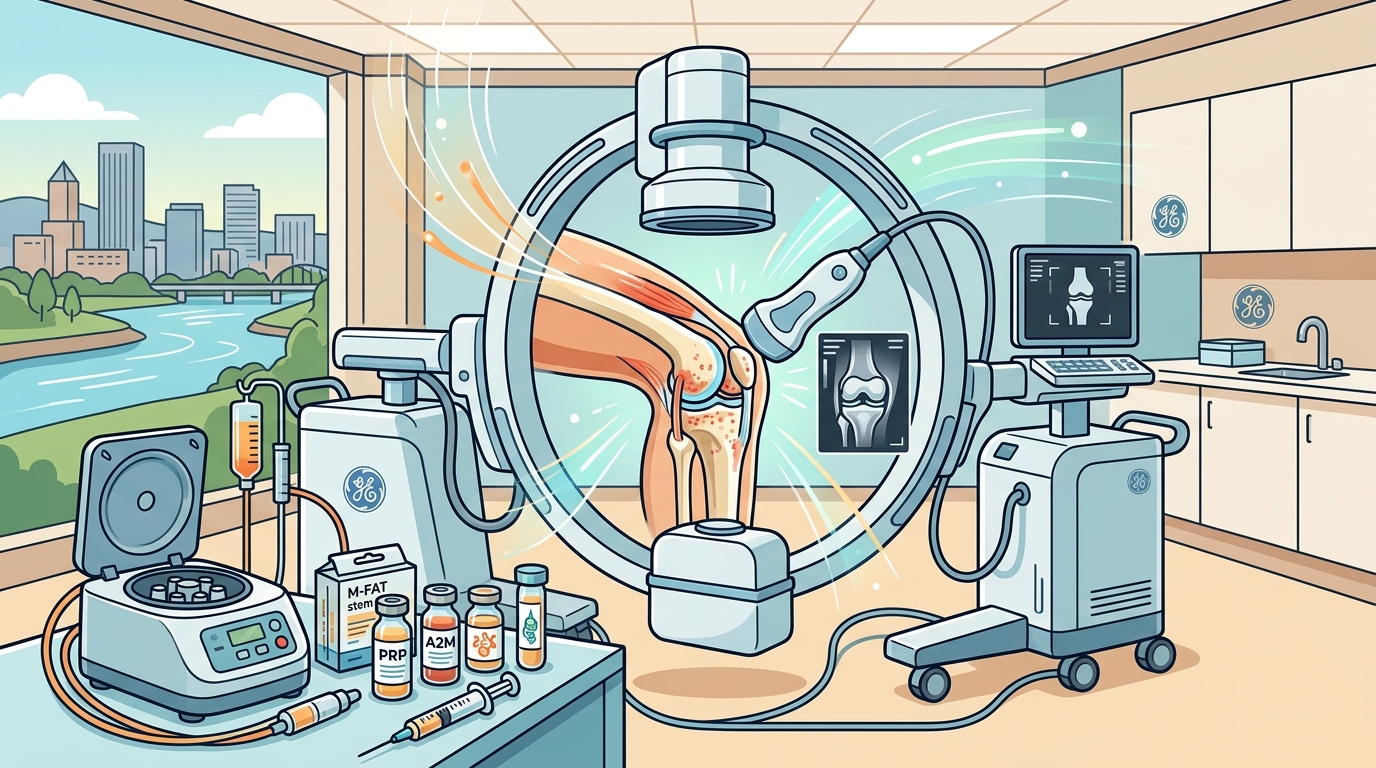
Recent meta-analyses have confirmed the efficacy of Platelet-Rich Plasma in the treatment of knee osteoarthritis. The data shows that PRP injections can provide significant pain relief and functional improvement compared to placebo or hyaluronic acid injections. At our clinic, we use ultrasound guidance to ensure the PRP is delivered exactly where it is needed for maximum therapeutic effect.
Biocellular Stem Cell Therapy
Biocellular Stem Cell Therapy utilizes autologous adipose tissue-derived stem cells. These cells are harvested from the patient's own body, typically through a minimally invasive liposuction procedure. The adipose tissue is then processed to isolate the stem cells and other regenerative components.
Adipose tissue-derived mesenchymal stem cells facilitate hematopoiesis and have shown advantages over bone marrow-derived stem cells in some contexts. These cells have the potential to differentiate into various tissue types, including cartilage, bone, and tendon. This makes them a powerful tool for treating degenerative joint diseases and severe soft tissue injuries.
Finding a Specialist in Your Region
For residents of Portland, Vancouver, and the Willamette Valley, access to high-quality regenerative medicine is critical. You need a specialist who not only understands the biology of healing but also possesses the technical skills to deliver these treatments safely and effectively.
Geographic Service Areas
We serve thousands of patients across the Oregon, Washington, and Portland regions. Our clinic is located inside the historic Foundry Building at Oswego Pointe, making it easily accessible for patients from downtown Portland and surrounding suburbs. For patients in Vancouver, Washington, and the Willamette Valley, we offer comprehensive care that eliminates the need for long-distance travel for complex orthopedic treatments.
Credentials and Expertise
When evaluating a specialist, look for physicians with extensive training in regenerative medicine. Our team includes Dr. Noel Peterson, Dr. Kristian Flores, Dr. Stacey Guggino, and Dr. Terry Manning II. Each of our doctors has decades of experience and is highly skilled in the arts of hands-on diagnosis, ultrasound imaging, and fluoroscopic guidance.
Proficiency in regenerative medicine requires many years of dedicated training and clinical experience. It is not enough to simply offer injections; the physician must be able to accurately diagnose the source of pain and select the appropriate treatment modality. Our doctors are board-certified and have performed over 40,000 regenerative injections, demonstrating a high level of clinical expertise.
The Critical Role of Ultrasound & Fluoroscopy
One of the most significant differentiators between a general practitioner and a specialized non-surgical orthopedic provider is the use of advanced imaging. Guessing where to inject is a thing of the past. Precision is paramount.
Ultrasound Imaging
Ultrasound imaging is equal to or better than MRI in evaluating most tendon and ligament disorders in the arms and legs. It allows for real-time visualization of the anatomy, enabling the physician to see the needle as it enters the tissue. This ensures that the treatment is delivered to the exact site of injury.
Our physicians are highly skilled in ultrasound imaging for both diagnosis and image-guided procedures. This expertise allows us to separate out individual tendon, ligament, and fascia fibers, get around nerves, and put the medicine into the correct location without a doubt. This level of precision reduces the risk of complications and maximizes the therapeutic benefit.
Fluoroscopic Guidance
For spinal and deep joint injections, fluoroscopy is often the gold standard. Fluoroscopic C-Arm guidance provides a live X-ray image that allows the physician to navigate the spine and deep joints with accuracy. This is essential for treating conditions such as facet joint arthritis, sacroiliac joint pain, and discogenic pain.
We provide evidence-based, ultrasound imaging and fluoroscopic C-Arm guidance in our non-surgical injection procedures. This dual-modality approach ensures that we can treat a wide range of conditions, from superficial tendon injuries to complex spinal pathologies, with the highest degree of safety and efficacy.
Comparison of Regenerative Options
Choosing the right treatment depends on the specific diagnosis, the severity of the condition, and the patient's overall health. The following table summarizes the key differences between our primary regenerative therapies.
| Treatment | Source | Best For | Key Benefit |
|---|---|---|---|
| Prolotherapy | Dextrose Solution | Ligament laxity, joint instability | Strengthens weakened tissues |
| Platelet Rich Plasma (PRP) | Patient's Blood | Tendon injuries, early osteoarthritis | High concentration of growth factors |
| Biocellular Stem Cell Therapy | Patient's Adipose Tissue | Severe osteoarthritis, cartilage loss | Regenerative potential of stem cells |
Key Takeaways
- Non-Surgical Options Exist: The vast majority of our patients achieve durable pain-free function without surgery, joint replacement, or drugs.
- Experience Matters: Oregon Regenerative Medicine has performed over 40,000 regenerative injections, establishing a track record of success.
- Precision is Key: Ultrasound and fluoroscopic guidance are essential for accurate diagnosis and effective treatment delivery.
- Regional Expertise: We serve patients in Portland, Vancouver, and the Willamette Valley with home-grown Pacific Northwest expertise.
- Comprehensive Care: Our team includes doctors with decades of experience in orthopedic medicine, functional medicine, and aesthetic arts.
- Evidence-Based: Our treatments are supported by extensive research, including meta-analyses on PRP and stem cell efficacy.
- Patient-Centered: We focus on empowering patients to live at their highest potential through education and personalized treatment plans.
Frequently Asked Questions
What is the difference between PRP and Stem Cell therapy?
PRP uses a concentration of the patient's own platelets to release growth factors that promote healing. Stem cell therapy uses autologous adipose-derived stem cells, which have the potential to differentiate into various tissue types and offer a more robust regenerative response for severe degenerative conditions.
Is regenerative medicine covered by insurance?
Insurance coverage for regenerative medicine varies by provider and plan. We recommend contacting your insurance company directly to inquire about coverage for specific CPT codes related to PRP, Prolotherapy, or stem cell therapy. Our office can also provide assistance with billing inquiries.
How long does recovery take after a regenerative injection?
Recovery times vary depending on the treatment and the condition being treated. Most patients can resume light activities within a few days, but full healing may take several weeks to months. We provide detailed post-treatment instructions to ensure optimal results.
Do you treat patients in Vancouver, Washington?
Yes, we serve patients from Portland, Vancouver, and the Willamette Valley. Our clinic is conveniently located in Portland, making it accessible for patients from across the region.
What conditions do you treat with Prolotherapy?
Prolotherapy is effective for a wide range of conditions, including knee osteoarthritis, shoulder pain, back pain, and ligament laxity. It is particularly useful for strengthening weakened ligaments and tendons.
Are the treatments painful?
While some discomfort is expected during the injection, we take every precaution to minimize pain. We use local anesthesia and advanced techniques to ensure patient comfort. Most patients report that the procedure is much less painful than they anticipated.
How many treatments will I need?
The number of treatments depends on the severity of the condition and the individual's healing response. Some patients see improvement after one session, while others may require a series of injections. We will develop a personalized treatment plan during your consultation.
Contact Oregon Regenerative Medicine
If you are suffering from chronic pain or a musculoskeletal injury, do not accept surgery as your only option. Contact Oregon Regenerative Medicine today to schedule a consultation. Our team of experienced physicians is ready to help you find a path to pain-free living.
Click here to contact us or call (503) 636-2734 to learn more about our non-surgical orthopedic services in Portland, Vancouver, and the Willamette Valley.