
Osteoarthritis affects over 32 million adults in the United States, making it one of the most prevalent causes of chronic pain and disability. According to the CDC, the condition significantly reduces mobility and quality of life for millions of individuals across the Pacific Northwest. For patients in Portland and the surrounding regions, avoiding invasive joint replacement surgery is often the primary goal. Oregon Regenerative Medicine has spent over 30 years pioneering non-surgical interventions that target the root causes of joint degeneration rather than merely masking symptoms. (Fluoroscopy Guided Spine Injections)
Why Choose Non-Surgical Options?
Many patients diagnosed with osteoarthritis are immediately presented with two choices: lifelong pain management or surgical intervention. However, modern regenerative medicine offers a powerful third path. Non-surgical treatments aim to repair damaged tissue, reduce inflammation, and restore function without the risks associated with open surgery.
Traditional surgery, such as total joint replacement, involves significant recovery times and potential complications including infection or implant failure. In contrast, regenerative therapies utilize the body's own biological resources to stimulate healing. Research indicates that platelet-rich plasma can significantly reduce pain and improve function in knee osteoarthritis patients. By choosing non-surgical options, patients in Portland can often return to their active lifestyles much faster than with traditional surgical routes.
The ORM Approach to Joint Regeneration
Oregon Regenerative Medicine (ORM) is the original home-grown Pacific Northwest expert in regenerative medicine. Located inside the historic Foundry Building at Oswego Pointe, our clinic has performed over 40,000 regenerative injections. We do not rely on guesswork. Our doctors are highly skilled in hands-on diagnosis, ultrasound imaging, and fluoroscopic guidance.
Our philosophy centers on empowering patients to create healthy, active longevity. We treat osteoarthritis and injuries of the back, neck, spine, hips, knees, shoulders, elbows, wrists, hands, feet, ankles, and TMJs. By using evidence-based, image-guided procedures, we ensure that the treatment reaches the exact site of injury. This precision is critical for effective tissue repair and long-term pain relief.
Platelet-Rich Plasma (PRP) Therapy
Platelet-Rich Plasma (PRP) is a concentration of a patient's own platelets, which contain growth factors that promote healing. A systematic review confirms the efficacy of intra-articular PRP injections for knee osteoarthritis. During this procedure, blood is drawn from the patient and spun in a centrifuge to isolate the platelet-rich layer.
When injected into the affected joint, PRP releases cytokines and growth factors that stimulate the body's natural repair mechanisms. This process helps to reduce inflammation and promote the regeneration of cartilage and other soft tissues. PRP is particularly effective for early to moderate stages of osteoarthritis and for treating tendon and ligament injuries that often accompany joint degeneration.
Stem Cell and Biocellular Therapies
For more advanced cases of osteoarthritis, stem cell therapy offers a robust regenerative option. Adipose-derived stem cells are harvested from the patient's own body fat tissue. These cells have the potential to differentiate into various cell types, including chondrocytes, which are responsible for cartilage formation.
Biocellular therapies combine these stem cells with other biological components to create a potent healing environment. Studies show that autologous adipose tissue-derived stem cells can regenerate articular cartilage in human knee osteoarthritis. This approach is ideal for patients who have not found relief with PRP alone or who have more significant structural damage.
At ORM, we use autologous Adipose Tissue Stem Cell Grafts to restore pain-free function. This treatment is particularly beneficial for inflammatory arthritis and degenerative diseases where the body's natural healing response is insufficient.
Prolotherapy for Joint Stability
Prolotherapy is a non-surgical treatment that involves injecting an irritant solution, typically dextrose, into damaged ligaments and tendons. This injection stimulates an inflammatory healing response, which leads to the proliferation of new connective tissue. The result is strengthened ligaments and improved joint stability.
Prolotherapy is often used in conjunction with PRP or stem cell therapy to address the underlying instability that contributes to osteoarthritis. By tightening loose ligaments, prolotherapy reduces abnormal joint movement and wear. Clinical trials have demonstrated the positive effects of dextrose prolotherapy for anterior cruciate ligament laxity and knee osteoarthritis.
Precision Guidance: Ultrasound and Fluoroscopy
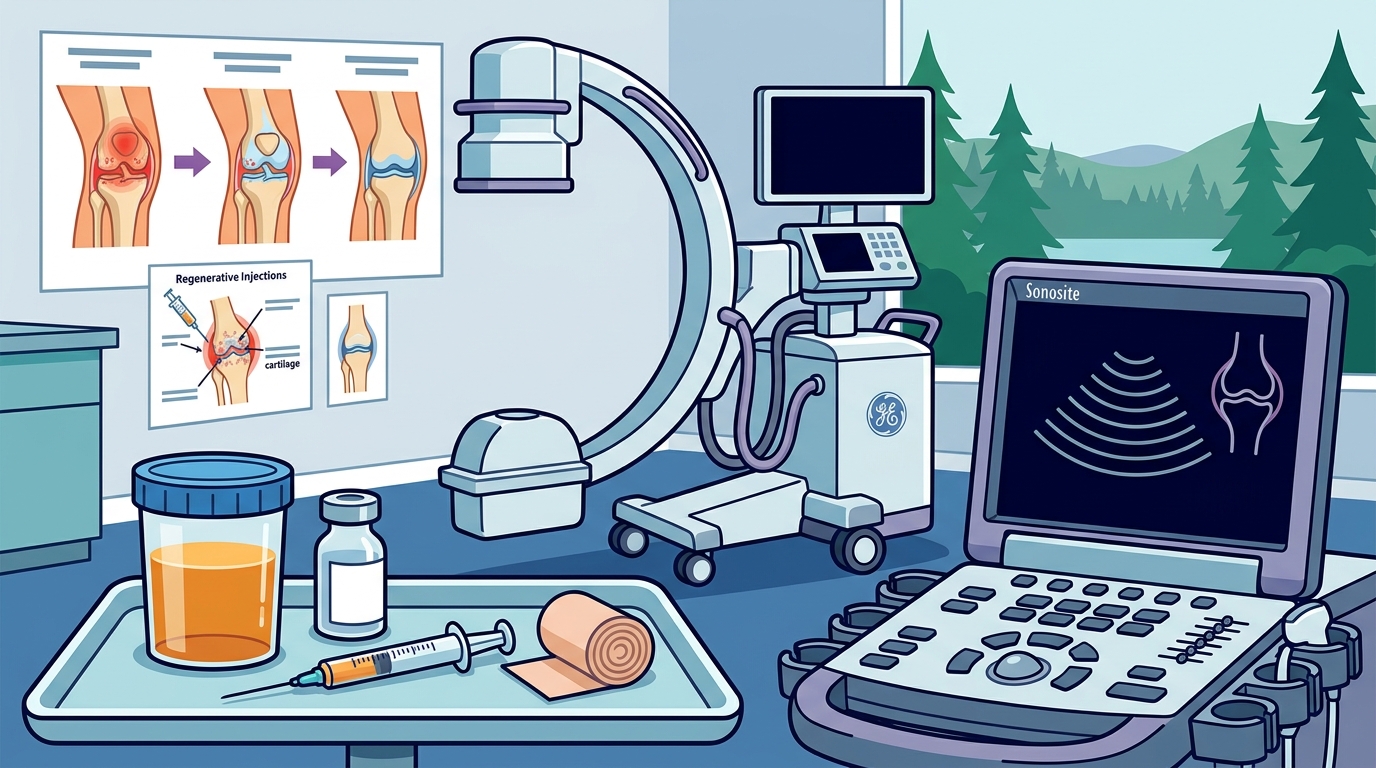
The accuracy of any injection therapy depends heavily on the precision of the delivery. At Oregon Regenerative Medicine, we utilize both ultrasound imaging and fluoroscopic C-Arm guidance for all our non-surgical injection procedures.
Ultrasound imaging is equal to or better than MRI in evaluating most tendon and ligament disorders in the arms and legs. It allows us to visualize the needle in real-time as it enters the tissue. This ensures that the PRP, stem cells, or prolotherapy solution is delivered exactly where it is needed. We are not guessing or using our fingers to get the needle "close to where it hurts." With ultrasound, we can separate out individual tendon, ligament, and fascia fibers, get around nerves, and put the medicine into the correct location without a doubt.
For spine and deeper joint structures, fluoroscopic guidance provides X-ray visualization. This is essential for treating osteoarthritis in the spine, hips, and other complex areas. Our doctors have decades of experience in these techniques, ensuring maximum safety and efficacy for every patient.
Comparing Treatment Modalities
Choosing the right treatment depends on the severity of the osteoarthritis, the specific joint involved, and the patient's overall health. The table below summarizes the key differences between our primary non-surgical options.
| Treatment | Best For | Source of Cells | Primary Mechanism |
|---|---|---|---|
| PRP Therapy | Early to moderate osteoarthritis, tendon injuries | Patient's own blood | Growth factor release to reduce inflammation |
| Stem Cell Therapy | Advanced osteoarthritis, significant cartilage loss | Patient's own adipose tissue | Cellular regeneration and tissue repair |
| Prolotherapy | Ligament laxity, joint instability | Dextrose solution | Stimulating natural healing response |
Key Takeaways
- Oregon Regenerative Medicine has over 30 years of experience in non-surgical orthopedic treatments.
- We have performed over 40,000 regenerative injections for patients in the Pacific Northwest.
- PRP therapy utilizes growth factors from the patient's blood to promote healing.
- Stem cell therapy uses adipose-derived cells to regenerate damaged cartilage and tissue.
- Prolotherapy strengthens ligaments to improve joint stability and reduce pain.
- All injections are guided by ultrasound or fluoroscopy for maximum precision.
- Non-surgical options offer a viable alternative to joint replacement surgery for many patients.
Frequently Asked Questions
Is non-surgical treatment for osteoarthritis covered by insurance?
Insurance coverage for regenerative medicine treatments varies by provider and plan. At ORM, we provide detailed documentation to assist with insurance claims, but many patients pay out-of-pocket for these specialized therapies.
How long does it take to see results from PRP or stem cell therapy?
Results vary by individual. Some patients experience relief within a few weeks, while others may take several months to see the full benefits of tissue regeneration. Most patients achieve durable pain-free function over time.
What is the difference between PRP and stem cell therapy?
PRP uses concentrated platelets from blood to release growth factors. Stem cell therapy uses adult adipose cells harvested from fat tissue to promote more extensive cellular regeneration. Stem cell therapy is often used for more advanced degeneration.
Are these procedures painful?
Patients may experience some discomfort during and after the procedure due to the inflammatory healing response. However, the use of local anesthesia and precise guidance minimizes pain. The relief from chronic osteoarthritis pain typically outweighs the temporary post-procedure soreness.
Can I combine PRP with Prolotherapy?
Yes, combining PRP with Prolotherapy is a common and effective strategy. Prolotherapy addresses ligament laxity, while PRP reduces inflammation and promotes tissue healing. This combined approach offers comprehensive joint stabilization.
How do you ensure accurate injection placement?
We use real-time ultrasound imaging and fluoroscopic C-Arm guidance. This allows our doctors to visualize the needle and target tissue precisely, ensuring the treatment is delivered exactly where it is needed.
Who is a good candidate for non-surgical osteoarthritis treatment?
Good candidates are individuals with mild to moderate osteoarthritis who wish to avoid surgery. Patients who have failed conservative treatments like physical therapy or NSAIDs are also excellent candidates for regenerative medicine.
Schedule Your Consultation
If you are suffering from osteoarthritis in Portland or the Pacific Northwest, you do not have to accept pain as your new normal. Oregon Regenerative Medicine offers expert, non-surgical treatments tailored to your specific needs. Our team of highly skilled doctors is ready to help you regain your mobility and quality of life.
Contact us today to schedule a consultation. Visit our contact page or call (503) 636-2734 to learn more about how PRP, stem cell, and prolotherapy can help you. We are located inside the historic Foundry Building at Oswego Pointe, serving patients across Oregon and Washington.