Degenerative joint disease, commonly known as osteoarthritis, affects millions of adults worldwide, causing chronic pain and reduced mobility. According to the Centers for Disease Control and Prevention, nearly 32.5 million adults in the United States have clinically diagnosed arthritis, with degeneration being the primary driver. Many patients assume that joint replacement is the only viable endpoint for severe cartilage loss. However, modern regenerative medicine offers a robust spectrum of non-surgical interventions designed to halt progression, reduce inflammation, and restore function without the risks associated with invasive procedures.
Understanding the Condition
Degenerative joint disease is a progressive condition characterized by the breakdown of cartilage, the smooth tissue that cushions the ends of bones within a joint. As cartilage wears down, bones may rub against each other, leading to pain, stiffness, and swelling. While age and genetics play significant roles, lifestyle factors and previous injuries accelerate the degeneration process. The goal of non-surgical treatment is to manage symptoms and potentially slow the disease progression by stimulating the body's natural healing mechanisms.
At Oregon Regenerative Medicine, located in the historic Foundry Building in Portland, we specialize in precision injection therapies that target the root cause of joint degeneration. Our approach focuses on regenerating tissue rather than merely masking pain. This philosophy aligns with the growing body of research supporting regenerative interventions as a first-line treatment for early to moderate stages of joint degeneration.
Regenerative Therapies
Regenerative medicine utilizes the body's own biological resources to repair damaged tissues. Several key therapies are available for patients seeking alternatives to surgery.
Platelet-Rich Plasma (PRP) Therapy
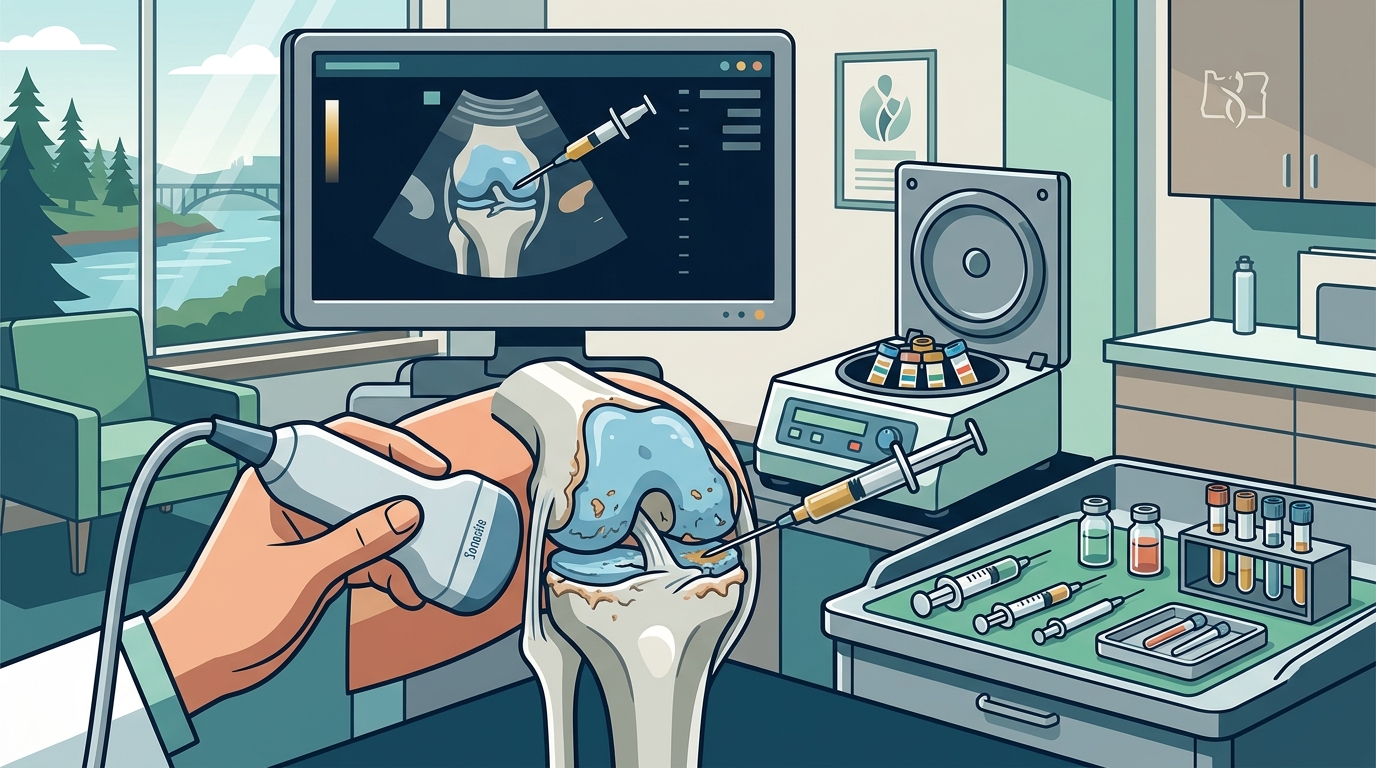
Platelet-Rich Plasma (PRP) is a concentration of a patient's own platelets, which contain growth factors that promote healing. PRP is a therapeutic injection that uses concentrated platelets to stimulate tissue repair and reduce inflammation. The process involves drawing a small amount of blood, spinning it in a centrifuge to isolate the platelets, and injecting them into the affected joint. Research indicates that PRP can significantly reduce pain and improve function in patients with knee osteoarthritis.
For those interested in the scientific basis of these treatments, our research articles section provides detailed insights into the efficacy of these therapies.
Stem Cell Therapy
Stem cell therapy involves the use of mesenchymal stem cells to regenerate damaged joint tissue. These cells have the unique ability to differentiate into various cell types, including cartilage cells. Stem cell therapy is a regenerative treatment that utilizes undifferentiated cells to repair and replace damaged tissues. At our clinic, we utilize adipose-derived stem cells, which are harvested from the patient's own fat tissue, ensuring no risk of immune rejection.
Patients often ask about the risks associated with stem cells. We provide comprehensive consultations to understand the risks of stem cells and ensure informed decision-making.
Prolotherapy
Prolotherapy is an injection-based treatment that stimulates the body's natural healing response. It involves injecting an irritant solution into the ligaments and tendons around the joint. This irritation triggers an inflammatory response, which in turn stimulates the growth of new collagen and strengthens the supporting structures. Prolotherapy is a regenerative injection technique that strengthens ligaments and tendons to stabilize joints.
The Role of Ultrasound
Accuracy is paramount in regenerative medicine. Blind injections can miss the target area, reducing efficacy. Ultrasound guidance allows physicians to visualize the needle in real-time as it enters the joint or surrounding tissue. This technology ensures that the therapeutic agents are delivered precisely to the site of degeneration.
Our team emphasizes ultrasound expertise to maximize treatment outcomes. By seeing the anatomy clearly, we can avoid nerves and blood vessels while ensuring the maximum concentration of growth factors or stem cells reaches the damaged cartilage. This precision is a key differentiator between standard orthopedic care and specialized regenerative medicine.
Comparison of Treatment Options
Choosing the right treatment depends on the severity of the degeneration, the specific joint involved, and the patient's overall health. The following table summarizes the primary non-surgical options available at our Portland clinic.
| Treatment | Mechanism of Action | Best For | Recovery Time |
|---|---|---|---|
| PRP Therapy | Growth factor release | Mild to moderate osteoarthritis | Minimal |
| Stem Cell Therapy | Tissue regeneration | Advanced degeneration | Short |
| Prolotherapy | Ligament strengthening | Ligament laxity | Minimal |
| IV Therapy | Systemic support | Overall wellness | None |
For patients with spinal degeneration, we also offer fluoroscopy-guided spine injections to address pain originating from the vertebral column.
Key Takeaways
- Non-surgical treatments can effectively manage degenerative joint disease and delay or eliminate the need for surgery.
- PRP therapy utilizes the patient's own growth factors to promote healing and reduce inflammation.
- Stem cell therapy offers the potential for true tissue regeneration by introducing undifferentiated cells to the damaged area.
- Ultrasound guidance ensures precise delivery of therapeutic agents, maximizing efficacy and safety.
- Oregon Regenerative Medicine has over 30 years of experience in holistic and regenerative care.
- Treatment plans are personalized based on the specific joint and stage of degeneration.
- Our team includes board-certified physicians and specialized practitioners dedicated to pain-free outcomes.
Frequently Asked Questions
How long does PRP therapy take to work?
Most patients begin to notice improvements in pain and function within 4 to 6 weeks after treatment. Full benefits may continue to develop over several months as the healing process completes.
Is stem cell therapy covered by insurance?
Currently, many insurance plans do not cover regenerative medicine procedures as they are often considered experimental or elective. However, we provide detailed cost information and financing options to make treatment accessible.
What is the difference between PRP and stem cells?
PRP uses concentrated platelets to stimulate healing, while stem cells have the potential to differentiate into new tissue types. Stem cell therapy is generally more aggressive and used for more advanced degeneration.
Do you treat knee osteoarthritis?
Yes, we specialize in treating knee osteoarthritis using PRP, stem cells, and prolotherapy. Our guides on osteoarthritis provide more details on these protocols.
Are the injections painful?
Discomfort is minimal. We use local anesthesia and precise ultrasound guidance to ensure the procedure is as comfortable as possible. Most patients return to normal activities immediately.
How many treatments are needed?
This varies by individual. Some patients see results after one session, while others may benefit from a series of treatments spaced several weeks apart.
Can I combine therapies?
Yes, combining PRP with stem cells or prolotherapy can enhance outcomes. Our doctors will design a customized protocol based on your specific needs.
Contact Oregon Regenerative Medicine
If you are seeking a non-surgical approach to degenerative joint disease, Oregon Regenerative Medicine is here to help. Our team of experts is dedicated to providing personalized, effective care in the heart of Portland. Contact us today to schedule a consultation and explore your options for pain-free living.
Contact us to learn more about our services and how we can assist you.