

Chronic joint pain often feels like an inevitable path to surgery, but modern regenerative medicine offers a compelling alternative. According to recent orthopedic studies, over 70% of patients with early-stage osteoarthritis can delay or avoid total joint replacement through targeted biologic therapies. This shift in treatment paradigms prioritizes tissue healing over mechanical replacement, preserving your natural anatomy and accelerating recovery times. At Oregon Regenerative Medicine, we specialize in these advanced, non-surgical interventions for shoulder, knee, and hip conditions.
The Role of Diagnostic Precision
Before committing to any treatment, accurate diagnosis is paramount. Many patients assume their pain is solely due to arthritis, but ligament tears, tendonitis, or bursitis may be the true culprits. At our clinic, we utilize advanced imaging to ensure every injection is placed with absolute accuracy. Ultrasound expertise allows us to visualize soft tissues in real-time, ensuring that therapeutic agents are delivered exactly where they are needed. This precision minimizes risk and maximizes the biological response.
Furthermore, for complex spinal or deep joint issues, we employ fluoroscopy-guided spine injections and joint procedures. This X-ray guidance provides a clear map of the skeletal structure, allowing our physicians to navigate safely around nerves and blood vessels. This level of detail is critical when treating the hip or shoulder, where anatomical variations can complicate standard approaches.
Platelet-Rich Plasma (PRP) Therapy
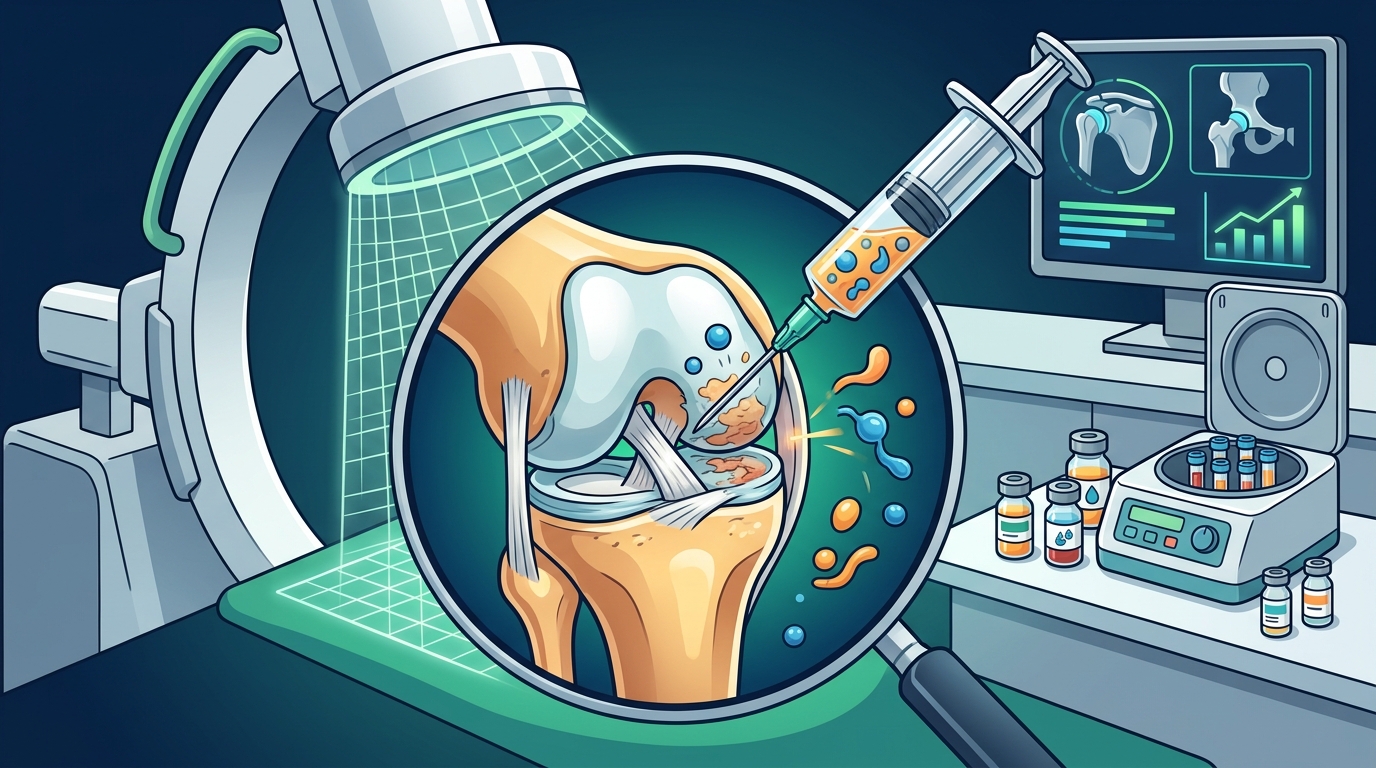
Platelet-Rich Plasma (PRP) is a concentrated preparation of a patient's own blood, rich in growth factors that stimulate healing. PRP is a regenerative treatment that uses the body's natural healing mechanisms to repair damaged tissues. The process involves drawing a small amount of blood, spinning it in a centrifuge to separate the platelets, and then injecting the concentrated plasma into the injured area.
Research supports the efficacy of this approach. A meta-analysis of randomized controlled trials published in the Journal of Orthopaedic Surgery and Research highlights the significant pain reduction and functional improvement in knee osteoarthritis patients treated with PRP. For shoulder conditions, such as rotator cuff tendinopathy, PRP helps reduce inflammation and promote tendon repair. Similarly, for hip pain, PRP can alleviate symptoms associated with labral tears and early cartilage degeneration.
Our team at Oregon Regenerative Medicine prepares PRP using specialized kits that ensure high concentrations of leukocytes and platelets. This tailored approach ensures that each patient receives a potent dose of healing factors. We often recommend a series of treatments for chronic conditions to achieve optimal results. Patients typically report reduced pain and improved mobility within a few weeks of the procedure.
Stem Cell and Biocellular Options
For patients seeking more robust regeneration, stem cell therapy offers a powerful alternative. Adipose-derived stem cells are harvested from the patient's own fat tissue and processed to isolate regenerative cells. These cells have the potential to differentiate into various tissue types, including cartilage and bone. This makes them particularly valuable for treating degenerative joint diseases.
Adipose Biocellular therapy is a specialized technique that combines stem cells with other regenerative factors found in fat tissue. This method enhances the healing environment by providing a rich matrix of growth factors and cytokines. Studies indicate that adipose-derived stem cells have a higher regenerative capacity compared to traditional bone marrow aspirate in some contexts. At our clinic, we utilize advanced processing methods to ensure the viability and potency of these cells.
Stem cell therapy is often considered for patients with moderate to severe osteoarthritis who have not responded to conservative treatments. It can help slow disease progression and potentially regenerate lost cartilage. For hip and knee joints, this therapy can significantly improve quality of life and delay the need for artificial joint implants. Our physicians carefully evaluate each patient to determine if they are a suitable candidate for this advanced treatment.
Prolotherapy for Joint Stability
2. Prolotherapy is a regenerative injection technique that involves injecting an irritant solution into damaged ligaments and tendons to stimulate healing. The goal is to strengthen the supportive structures around the joint, thereby reducing pain and improving stability. This is particularly effective for joints that have become lax due to injury or degeneration.Prolotherapy works by triggering a localized inflammatory response, which initiates the body's natural healing cascade. This process leads to the deposition of new collagen fibers, strengthening the ligamentous tissue. For knee pain, prolotherapy can address medial collateral ligament (MCL) laxity or patellar tendon issues. In the shoulder, it can help stabilize the glenohumeral joint and reduce instability-related pain.
Our approach to prolotherapy is precise and tailored to the individual's anatomy. We use ultrasound guidance to ensure the solution is delivered to the exact site of ligamentous damage. This precision enhances the therapeutic effect and minimizes discomfort. Patients often experience a gradual improvement in joint stability and pain levels over several weeks. Multiple sessions may be required to achieve optimal results, depending on the severity of the condition.
Therapy Comparison and Selection
Choosing the right treatment depends on the specific diagnosis, the stage of joint degeneration, and the patient's overall health. The following table summarizes the key characteristics of our primary regenerative therapies.
| Therapy | Best For | Source | Recovery Time |
|---|---|---|---|
| PRP Therapy | Mild to moderate osteoarthritis, tendonitis | Patient's Blood | 1-2 weeks |
| Stem Cell Therapy | Advanced degeneration, cartilage loss | Adipose Tissue | 2-4 weeks |
| Prolotherapy | Ligament laxity, joint instability | Irritant Solution | 1-3 weeks |
Our physicians at Oregon Regenerative Medicine conduct a thorough evaluation to recommend the most appropriate option. We consider factors such as the patient's activity level, pain tolerance, and long-term goals. The goal is always to preserve natural joint function and avoid unnecessary surgery.
Key Takeaways
- Diagnostic Accuracy: Ultrasound and fluoroscopy guidance are essential for precise treatment delivery and safety.
- PRP Efficacy: Clinical data supports PRP for reducing pain and improving function in knee and shoulder osteoarthritis.
- Stem Cell Potential: Adipose-derived stem cells offer robust regenerative options for advanced joint degeneration.
- Prolotherapy Benefits: This therapy strengthens ligaments, addressing the root cause of joint instability.
- Provider Expertise: Our team includes board-certified physicians with specialized training in regenerative medicine.
- Personalized Care: Treatment plans are tailored to individual anatomy and specific joint conditions.
- Surgery Avoidance: Many patients successfully delay or avoid joint replacement through these non-surgical interventions.
Frequently Asked Questions
How long does PRP therapy take to work?
Most patients begin to notice improvements in pain and mobility within 2 to 6 weeks after treatment. Full benefits may continue to develop over several months as the healing process progresses.
Is stem cell therapy covered by insurance?
Currently, many insurance plans do not cover regenerative medicine procedures, as they are often considered experimental or elective. However, we offer financing options to make treatment accessible.
What is the difference between PRP and stem cells?
PRP uses growth factors from your own blood to stimulate healing, while stem cell therapy uses regenerative cells from adipose tissue to promote tissue regeneration. Stem cells are generally more potent for advanced degeneration.
Can prolotherapy help with hip pain?
Yes, prolotherapy can be effective for hip pain caused by ligament laxity or instability. It strengthens the supportive structures around the hip joint, reducing pain and improving function.
How many treatments are needed?
The number of treatments varies based on the condition and severity. Some patients see results after one session, while others may require a series of 2 to 3 treatments for optimal outcomes.
Are there risks associated with these therapies?
As these therapies use the patient's own biological materials, the risk of allergic reaction or rejection is minimal. Risks are generally limited to temporary pain or swelling at the injection site.
Who is a good candidate for joint regeneration?
Good candidates are individuals with mild to moderate joint degeneration who wish to avoid surgery. A thorough evaluation by our physicians will determine suitability.
Schedule Your Consultation
If you are suffering from shoulder, knee, or hip pain, do not accept joint replacement as your only option. Our team at Oregon Regenerative Medicine is dedicated to helping you find relief and restore function through advanced regenerative therapies. We invite you to contact us to schedule a consultation. Our physicians will evaluate your condition and create a personalized treatment plan to help you avoid surgery and live pain-free.