
Non-Surgical Osteoarthritis Treatment in Portland, Oregon
Osteoarthritis affects roughly 32.5 million adults in the United States, making it the most common form of arthritis. For patients in Portland and the Pacific Northwest, the idea of joint replacement surgery can feel overwhelming. The good news is that regenerative medicine now offers clinically supported, non-surgical alternatives. From platelet-rich plasma (PRP) to prolotherapy and adipose tissue stem cell grafts, providers like Oregon Regenerative Medicine in Lake Oswego have helped thousands of patients reclaim mobility without going under the knife.
What Is Osteoarthritis and Why Does It Progress?
Osteoarthritis (OA) is a degenerative joint disease characterized by the breakdown of protective cartilage that cushions the ends of bones. Over time, this cartilage loss leads to pain, stiffness, and reduced mobility in the knees, hips, shoulders, and spine.
According to the CDC, there are 9.9 million office visits annually with osteoarthritis as the primary diagnosis. Risk factors include aging, obesity, prior joint injury, and nutritional deficiencies. Research cited by Oregon Regenerative Medicine notes that vitamin D deficiency can accelerate cartilage distress.
Non-Surgical Treatment Options Overview
Non-surgical treatment for osteoarthritis is any therapy that reduces pain and restores joint function without invasive surgical procedures. International evidence-based guidelines recommend starting with non-surgical treatments before considering surgery.
Conventional Approaches
Physical therapy, weight management, anti-inflammatory medications, and corticosteroid injections remain common first-line strategies. However, corticosteroid benefits often fade within months and may accelerate cartilage breakdown over time.
Regenerative Approaches
Regenerative medicine uses the body's own biology to promote tissue repair. In Portland, Oregon Regenerative Medicine offers three core biocellular therapies: prolotherapy, platelet-rich plasma (PRP), and adipose-derived stem cell grafts. These treatments enhance natural repair cycles in chronically injured joints.
PRP Therapy: What the Latest Research Shows
Platelet-rich plasma (PRP) is a concentrated preparation of a patient's own blood platelets that delivers growth factors directly into damaged tissue. A 2025 narrative review in MDPI journals synthesizing 40 high-quality studies found that PRP injections demonstrate superior pain relief and functional improvement compared to hyaluronic acid and corticosteroids, especially in mild to moderate OA.
Additional 2024 and 2025 meta-analyses confirm that PRP produces sustained improvements in pain and function for 12 to 24 months. Emerging imaging studies also suggest PRP may slow cartilage loss progression. At Oregon Regenerative Medicine, PRP is prepared in-house and commonly used for musculoskeletal conditions including osteoarthritis, tendon injuries, and back pain.
Prolotherapy for Joint Pain Relief
Prolotherapy is a regenerative injection technique that uses a dextrose solution to stimulate the body's natural healing response in damaged ligaments, tendons, and joints. A 2025 review in Frontiers in Endocrinology examined dextrose prolotherapy's mechanisms and efficacy in osteoarthritis management.
Dr. Noel Peterson, Medical Director of Oregon Regenerative Medicine, is one of only three physicians certified in prolotherapy in the Pacific Northwest. He has taught prolotherapy nationally and internationally, and in 2019 received naturopathic medicine's Living Legend Award from the OANP and NUNM.
Adipose Stem Cell Therapy for Advanced OA
Adipose stem cell therapy is a regenerative procedure that harvests stem cells from a patient's own fat tissue and injects them into damaged joints. These cells can differentiate into cartilage-forming cells and release growth factors that modulate immune response and promote tissue repair.
For patients with more advanced hip and knee arthritis, stem cell therapy combined with PRP offers the strongest alternative to surgery. Oregon Regenerative Medicine prepares M-FAT (micro-fragmented adipose tissue) on-site, and a published 2-year PRP study highlighted on their site confirms cartilage repair in osteoarthritis of the knee.
Treatment Comparison Table
| Treatment | Mechanism | Best For | Duration of Relief | Invasiveness |
|---|---|---|---|---|
| Corticosteroid Injection | Anti-inflammatory suppression | Short-term flare relief | Weeks to a few months | Low (injection) |
| Hyaluronic Acid | Joint lubrication | Mild OA symptom management | 3 to 6 months | Low (injection) |
| Prolotherapy (Dextrose) | Stimulates ligament/tendon repair | Joint instability, mild to moderate OA | Months to years | Low (injection series) |
| PRP Therapy | Growth factor delivery, tissue regeneration | Mild to moderate OA (KL Grades I-III) | 12 to 24 months | Low (blood draw + injection) |
| Adipose Stem Cell Graft | Cell differentiation, anti-inflammatory | Moderate to advanced OA | 1 to 3+ years (varies) | Moderate (mini-lipoaspiration + injection) |
| Joint Replacement Surgery | Mechanical replacement | End-stage OA | 15 to 20 years (implant lifespan) | High (major surgery) |
Why Oregon Regenerative Medicine Stands Out
Located on the Willamette River in Lake Oswego since 1978, Oregon Regenerative Medicine has provided non-surgical joint treatments for over four decades. The practice combines regenerative orthopedics with integrative medicine, including naturopathic primary care, hormone optimization, IV nutrient therapy, and acupuncture.
Advanced Imaging and In-House Lab
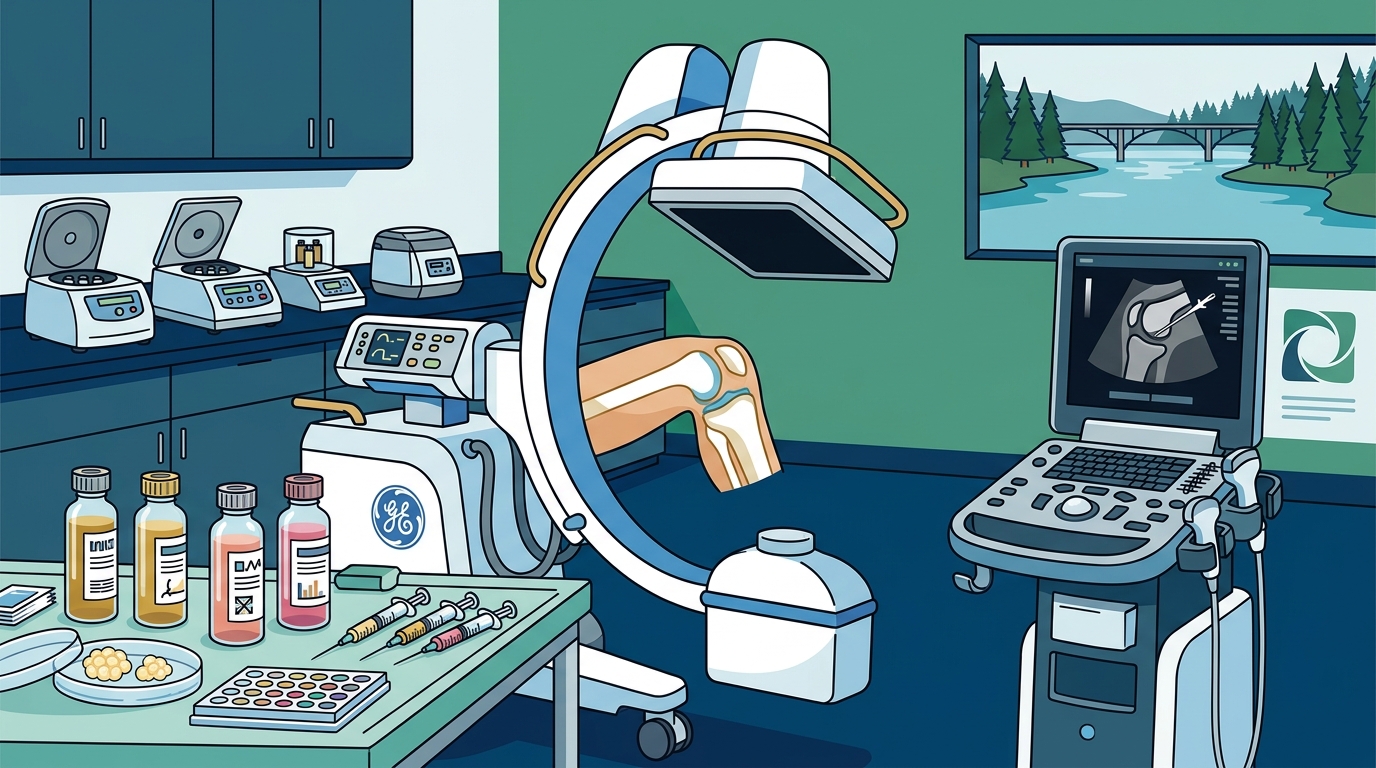
All regenerative injections are performed under image guidance using a GE OEC One Flat Panel C-Arm fluoroscopy system and four Sonosite ultrasound units. PRP, PRF, M-FAT, A2M, and platelet lysates are all prepared in the clinic's own laboratory, ensuring quality control from preparation to injection.
Proven Track Record
The clinic has successfully treated thousands of osteoarthritic hips, knees, shoulders, and spines. The vast majority of patients achieve durable, pain-free function without surgery, joint replacement, or long-term medications.
Key Takeaways
- Osteoarthritis affects 32.5 million U.S. adults, making non-surgical alternatives increasingly important.
- PRP therapy delivers superior pain relief over corticosteroids and hyaluronic acid, with benefits lasting 12 to 24 months.
- Prolotherapy stimulates natural ligament and tendon repair using simple dextrose injections.
- Adipose stem cell therapy offers the strongest non-surgical option for moderate to advanced OA.
- Oregon Regenerative Medicine in Lake Oswego has specialized in regenerative orthopedics since 1978.
- Image-guided injections using fluoroscopy and ultrasound improve treatment precision and outcomes.
- All biologic preparations (PRP, M-FAT, A2M) are made on-site for maximum quality control.
Frequently Asked Questions
What is PRP therapy for osteoarthritis?
PRP therapy is a regenerative treatment that concentrates platelets from your own blood and injects them into a damaged joint. The platelets release growth factors that promote tissue healing, reduce inflammation, and may slow cartilage loss.
How long do PRP results last for knee osteoarthritis?
Research from 2024 and 2025 shows PRP injections can provide sustained pain relief and functional improvement for 12 to 24 months, significantly outlasting corticosteroid injections.
Is prolotherapy effective for osteoarthritis?
Yes. Studies show that dextrose prolotherapy can significantly improve pain and disability in OA patients. It is particularly valued for its low cost, long-term efficacy, and minimal complication rates.
What is adipose stem cell therapy?
Adipose stem cell therapy extracts stem cells from your own fat tissue and injects them into damaged joints. These cells release anti-inflammatory and regenerative compounds that support cartilage repair and tissue regeneration.
Who is a good candidate for non-surgical OA treatment?
Most patients with mild to advanced osteoarthritis who want to delay or avoid joint replacement surgery are candidates. A consultation with a regenerative medicine specialist can determine which therapy best fits your condition.
Does insurance cover PRP or stem cell therapy?
Most insurance plans do not cover PRP or stem cell therapies. Oregon Regenerative Medicine can discuss costs and payment options during your consultation. Some patients use HSA or FSA funds.
How is Oregon Regenerative Medicine different from other clinics?
The practice has over 45 years of experience, in-house biologic preparation, fluoroscopy and ultrasound guidance for every injection, and a physician who is one of only three certified prolotherapy specialists in the Pacific Northwest.
Where is Oregon Regenerative Medicine located?
The clinic is located in Lake Oswego, Oregon, on the Willamette River, serving patients throughout Portland, the greater metro area, and the Pacific Northwest.
Schedule Your Consultation
If you are living with osteoarthritis pain and want to explore non-surgical treatment options, take the next step. Contact Oregon Regenerative Medicine at (503) 636-2734 to schedule a consultation with Dr. Noel Peterson and learn which regenerative therapy is right for your joints.