

If you have been told that surgery or a lifetime on pain medications is your only option, biocellular joint regeneration may offer a different path. This advanced, non-surgical approach uses your body's own repair cells to treat a wide range of musculoskeletal conditions. At Oregon Regenerative Medicine in Lake Oswego, Oregon, physicians have performed over 40,000 regenerative injections since 1978, treating everything from osteoarthritic knees to damaged rotator cuffs. Below, we break down the specific conditions that respond to biocellular therapy, the science behind it, and what you should know before scheduling a consultation.
What Is Biocellular Joint Regeneration?
Biocellular joint regeneration is a non-surgical treatment category that combines autologous biological substances to promote tissue repair inside damaged joints. The term "biocellular" refers to therapies that use living cells and growth factors harvested from your own body, primarily from adipose (fat) tissue and blood platelets.
Orthobiologics is the broader field encompassing these treatments. According to research published in Gels (2025), orthobiologics display significant ability to facilitate healing as a non-surgical intervention strategy. At Oregon Regenerative Medicine, three primary biocellular therapies are offered: prolotherapy, platelet rich plasma (PRP), and adipose tissue graft therapy.
Osteoarthritis of the Knee, Hip, and Shoulder
Osteoarthritis (OA) is a degenerative disorder associated with cartilage loss and is a leading cause of disability worldwide. It is estimated that symptomatic OA affects roughly 27 to 31 million adults in the United States alone, according to data cited on ClinicalTrials.gov.
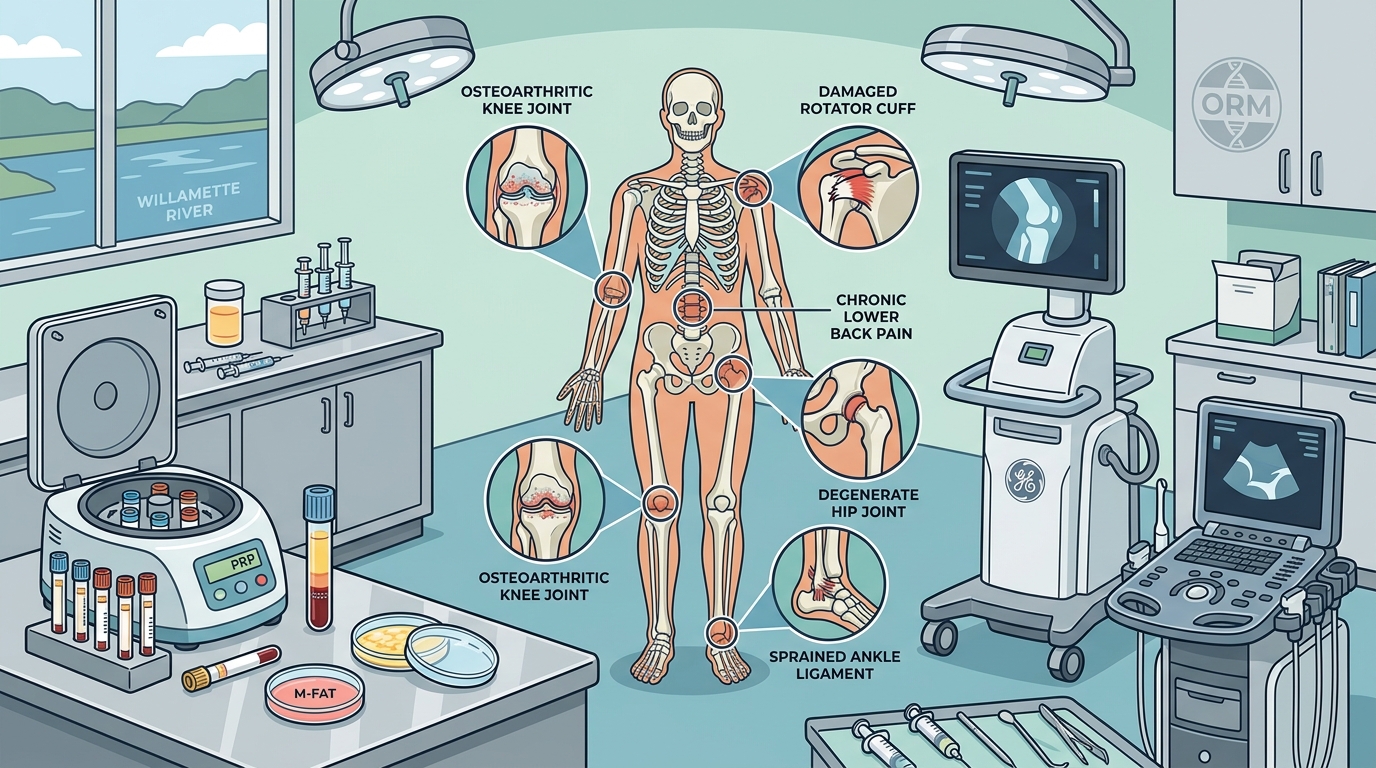
Biocellular therapies target OA at its source. Oregon Regenerative Medicine has successfully treated thousands of osteoarthritic hips, knees, rotator cuffs, shoulders, elbows, wrists, hands, feet, ankles, and TMJs. A 2026 systematic review in the Indian Journal of Orthopaedics confirmed that both PRP and adipose-derived cell-based therapies significantly improved pain, function, and quality of life with no reported complications.
Knee Osteoarthritis
Knee OA is the most commonly studied condition in biocellular research. A clinical case series discussed on the ORM blog demonstrated that adipose tissue-derived stem cells combined with PRP could regenerate cartilage-like tissue in knee OA patients. A separate two-year PRP study featured by ORM showed significant improvement in pain and disability across all participants.
Hip Osteoarthritis
Hip OA often leads patients toward total hip replacement. Adipose biocellular therapy with adipose-derived tissue grafts, when combined with PRP, offers a compelling alternative. Many patients at ORM who were facing hip replacement have experienced substantial relief and returned to active lifestyles.
Tendon and Ligament Injuries
Tendon and ligament damage accounts for a large share of orthopedic complaints. Common injuries treated with biocellular regeneration include meniscus tears, MCL injuries, ACL injuries, and rotator cuff tears. Regenerative Orthopedic Medicine uses non-surgical injection procedures for the permanent repair of damaged tendons, ligaments, and joints.
Oregon Regenerative Medicine has published 16 case studies of rotator cuff injuries showing how patients responded to prolotherapy and PRP. Unlike cortisone injections, which permanently weaken connective tissue, prolotherapy restores normal strength, elasticity, and function.
Spinal Conditions: Back, Neck, and Sacroiliac Pain
Chronic spinal pain is one of the most debilitating conditions patients bring to regenerative clinics. Oregon Regenerative Medicine specializes in osteoarthritis and injuries of the back, neck, and spine using image-guided injection techniques.
Sacroiliac Joint Pain
Sacroiliac sprain is one of the most common causes of lower back pain. According to ORM's clinical experience detailed on their sacroiliac pain page, prolotherapy and PRP injections remain the most effective and definitive treatment for this condition.
Cervical and Lumbar Arthritis
Prolotherapy and PRP for arthritis of the cervical, thoracic, and lumbar spine provides relief to over 85% of patients willing to try it, based on ORM's clinical outcomes. Fluoroscopy-guided and ultrasound-guided injections ensure precision delivery to the affected spinal structures.
Small Joint Conditions: Hands, Wrists, Feet, and Ankles
Biocellular therapy is not limited to large joints. Smaller joints in the hands, wrists, feet, and ankles also respond well. A clinical trial registered on ClinicalTrials.gov evaluated microfat and PRP for radiocarpal (wrist) osteoarthritis, noting that adipose tissue contains a large proportion of mesenchymal stem cells able to differentiate into cartilage cells.
ORM routinely treats over 20 different joints per day using prolotherapy injections with and without PRP, from ankles and knees to hips and necks. TMJ dysfunction is another small-joint condition that benefits from regenerative injection therapy.
How Biocellular Therapy Works: PRP, Prolotherapy, and Adipose Grafts
Understanding the three core therapies helps clarify which conditions respond best to each approach.
| Therapy | Source Material | Mechanism | Best For |
|---|---|---|---|
| Prolotherapy | Dextrose solution | Stimulates wound-repair cascade to restart innate healing | Ligament sprains, joint instability, mild OA |
| PRP (Platelet Rich Plasma) | Patient's own blood platelets | Concentrated growth factors drive tissue repair and reduce inflammation | Moderate OA, tendon injuries, cartilage loss |
| Adipose Tissue Graft | Patient's own fat tissue (rich in MSCs) | Mesenchymal stem cells differentiate into cartilage, bone, and connective tissue | Advanced OA, severe cartilage degeneration, joint replacement alternatives |
Prolotherapy is a non-surgical injection procedure for promoting repair of damaged connective tissue. PRP is a concentrate of your own blood platelets containing hundreds of identified growth and repair compounds. Adipose tissue graft therapy harvests mesenchymal stem cells from your own fat, the most abundant source of reparative cells in the human body. All procedures at ORM are guided by ultrasound and fluoroscopic C-Arm imaging for precision placement.
Key Takeaways
- Biocellular joint regeneration treats osteoarthritis, tendon tears, ligament injuries, and spinal pain without surgery.
- The most commonly treated joints include knees, hips, shoulders, spine, wrists, ankles, and TMJs.
- Three core therapies are used: prolotherapy, PRP, and adipose tissue grafts, often in combination.
- Clinical research confirms that both PRP and adipose-derived therapies improve pain, function, and quality of life.
- All procedures use autologous (your own) biological materials, minimizing rejection risk.
- Image-guided injections with ultrasound and fluoroscopy ensure accurate delivery to the target tissue.
- Oregon Regenerative Medicine has performed over 40,000 regenerative injections since 1978.
Frequently Asked Questions
What is biocellular joint regeneration?
Biocellular joint regeneration is a category of non-surgical treatments that use your body's own cells and growth factors, harvested from adipose tissue and blood, to repair damaged joints, tendons, and ligaments.
Which joints can be treated with biocellular therapy?
Treatable joints include knees, hips, shoulders, elbows, wrists, hands, feet, ankles, TMJs, and the spinal facet joints of the cervical, thoracic, and lumbar spine.
Is biocellular therapy an alternative to joint replacement surgery?
For many patients, yes. Adipose biocellular therapy combined with PRP offers a viable alternative to major surgery and joint replacement procedures, particularly for those with moderate to advanced osteoarthritis.
How does PRP differ from adipose tissue graft therapy?
PRP uses concentrated platelets from your blood to deliver growth factors. Adipose tissue graft therapy harvests mesenchymal stem cells from your fat tissue, providing a richer source of reparative cells for more advanced degeneration.
Is biocellular regeneration safe?
Because the therapies use autologous materials (your own tissue), the risk of rejection or allergic reaction is extremely low. A 2026 systematic review found no reported complications across multiple clinical trials of PRP and adipose-derived therapies for knee OA.
How many treatments are typically needed?
Treatment plans vary by condition and severity. Some patients see significant improvement after one to two sessions, while chronic or advanced cases may require a series of treatments over several months.
Does insurance cover biocellular joint regeneration?
Most insurance plans do not currently cover regenerative injection therapies. Oregon Regenerative Medicine can discuss payment options during your consultation.
Who is a good candidate for biocellular therapy?
Candidates typically include people with joint pain from osteoarthritis, ligament or tendon injuries, or spinal degeneration who want to avoid or delay surgery. A thorough evaluation including history, imaging, and diagnostic ultrasound determines candidacy. Learn more on ORM's candidacy page.
Schedule Your Biocellular Therapy Consultation
If you are dealing with joint pain, osteoarthritis, or a tendon or ligament injury and want to explore non-surgical options, Oregon Regenerative Medicine can help. With over four decades of clinical experience and more than 40,000 regenerative injections performed, the team at ORM in Lake Oswego, Oregon, will evaluate your condition and recommend the best biocellular approach for your needs. Contact Oregon Regenerative Medicine today to schedule your consultation and take the first step toward lasting, drug-free pain relief.