
Adipose tissue graft therapy is a regenerative treatment that uses your own fat cells to alleviate joint pain and restore function without surgery. If you have been told that joint replacement is your only option, this procedure may offer a powerful alternative. At Oregon Regenerative Medicine in Lake Oswego, Oregon, adipose tissue grafts have helped patients avoid surgery since the practice opened in 1978. Below, we walk you through every stage of the procedure so you know exactly what to expect before, during, and after treatment.
What Is Adipose Tissue Graft Therapy?
Adipose tissue graft therapy is a form of biocellular orthopedic treatment that harvests fat tissue rich in mesenchymal stem cells (MSCs) from your own body and re-injects it into damaged joints or tissues. Autologous adipose graft therapy is a procedure formerly known as a type of "stem cell therapy" that uses your own fat cells and tissue to alleviate pain and restore joint function.
Mesenchymal stem cells (MSCs) are multipotent cells found abundantly in adipose tissue that can differentiate into cartilage, bone, and connective tissue. Adipose tissue is recognized as a valuable source of cells with angiogenic, immunomodulatory, reparative, and antifibrotic properties. Because the graft comes from your own body, there is virtually no risk of immune rejection.
Who Is a Good Candidate?
Adipose tissue graft therapy is best suited for patients dealing with moderate-to-severe osteoarthritis, chronic tendon injuries, or ligament damage who want to avoid or delay joint replacement surgery. It can be an effective alternative to major surgery and joint replacement procedures for hips, knees, shoulders, and other joints.
Oregon Regenerative Medicine has successfully treated thousands of osteoarthritic hips, knees, rotator cuffs, shoulders, elbows, wrists, and TMJs. Not every patient is a candidate. A thorough evaluation determines whether this treatment is the right fit for your specific condition.
Pre-Procedure Evaluation
Before any treatment begins, your physician performs a comprehensive assessment. At Oregon Regenerative Medicine, this includes a thorough history, physical exam, review of X-rays and MRIs, and diagnostic ultrasound imaging. Unlike a static MRI snapshot, real-time ultrasound enables a functional evaluation of the joint during movement.
Why Diagnostic Ultrasound Matters
Musculoskeletal ultrasound (MSKUS) is a dynamic imaging modality that allows physicians to correlate hands-on palpation simultaneously with direct ultrasound images. Oregon Regenerative Medicine uses four Sonosite ultrasound systems for comprehensive guided evaluation and procedures. This step ensures accurate diagnosis before any injection is performed.
Setting Realistic Expectations
The number of treatments required depends on the condition being treated, the severity of injury, and how long the injury has been present. Your physician will outline a personalized treatment plan during the consultation.
Step-by-Step Procedure Day
On the day of your adipose tissue graft procedure, you can expect the following stages:
Step 1: Tissue Harvesting
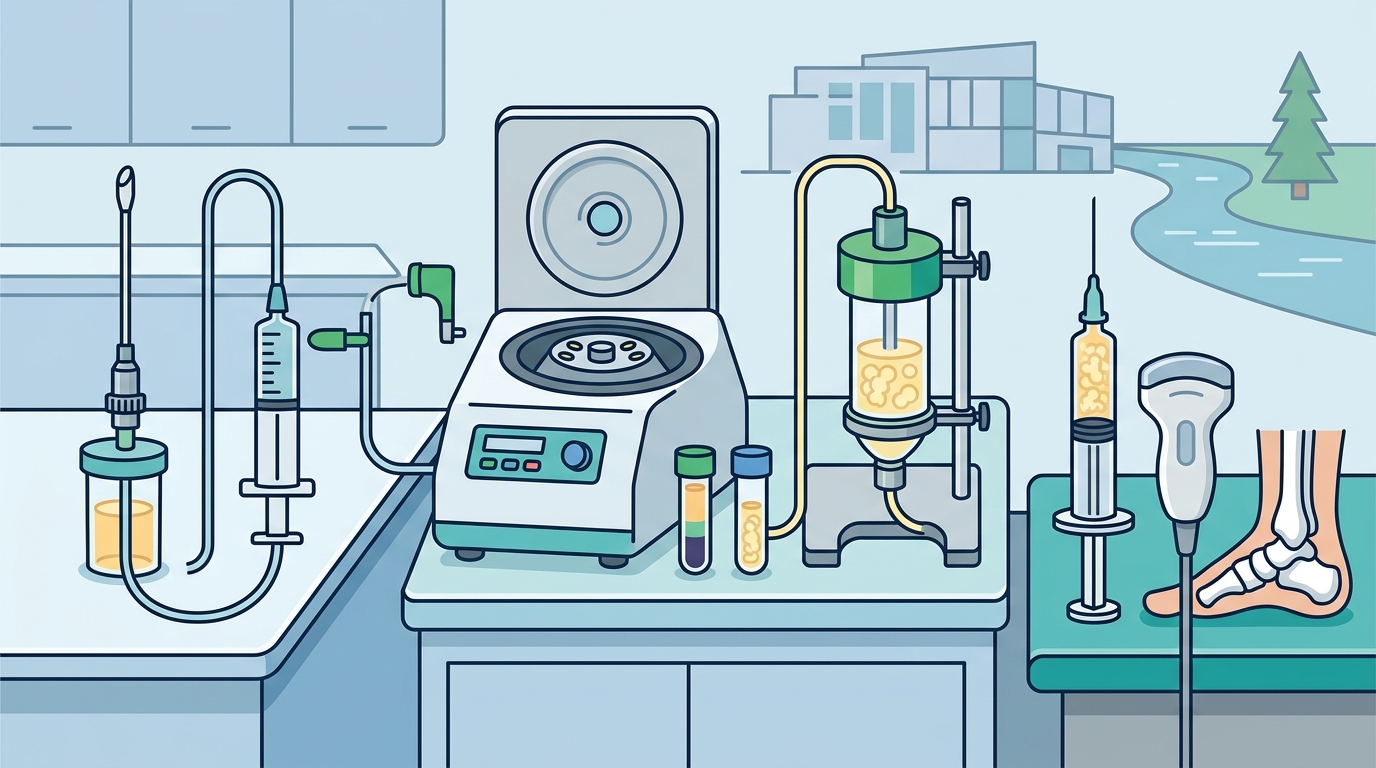
The procedure begins with a mini-lipoaspiration. A small area, typically around the abdomen or flank, is numbed with local anesthesia. A blunt cannula is used to gently extract a small volume of fat tissue. This harvesting step takes roughly 20 to 30 minutes.
Step 2: In-House Laboratory Processing
The harvested fat is processed on-site in Oregon Regenerative Medicine's in-house laboratory. Processing methods such as micro-fragmentation preserve the native extracellular matrix and perivascular structures, maintaining a three-dimensional scaffolding that supports cell viability. The result is a concentrated biocellular graft containing MSCs, growth factors, and bio-scaffolding. Oregon Regenerative Medicine prepares M-FAT, PRP, PRF, A2M, and platelet lysates in-house for maximum potency.
Step 3: Image-Guided Injection
The processed graft is then injected precisely into the target tissue. Depending on the joint, injections may be guided by ultrasound or by fluoroscopy using the clinic's GE OEC One Flat Panel C-Arm system. Fluoroscopy is ideally suited for guiding injections directly into intervertebral discs, while ultrasound excels for peripheral joints.
The Role of Image Guidance
Accurate needle placement is one of the three essential factors for positive results, alongside accurate diagnosis and product quality. At Oregon Regenerative Medicine, getting positive results comes down to accurate diagnosis, accuracy of the injections, and the purity and potency of the biologic product injected.
Image guidance is the standard of care for regenerative injections. Without it, even the most potent biologic product may be delivered to the wrong tissue. Oregon Regenerative Medicine's imaging suite combines fluoroscopy for spinal procedures and ultrasound for extremity and soft-tissue work, ensuring every injection hits its target.
Recovery Timeline and Follow-Up
Recovery from adipose tissue graft therapy is far less demanding than surgical alternatives. Most patients experience mild soreness at the harvest and injection sites for a few days. Ice, rest, and over-the-counter pain relief are usually sufficient.
Improvements typically begin within weeks. One patient reported significant pain relief within five weeks of the first treatment and 80-85% restoration of hip function within eight months. Follow-up adipose graft treatments are generally spaced about one year apart if additional treatments are needed.
Your physician may also recommend complementary A2M therapy or PRP sessions to enhance and maintain results between adipose graft procedures.
Adipose Tissue Grafts vs. PRP: Key Differences
Both therapies belong to the regenerative medicine spectrum, but they differ in source material, processing, and ideal use cases. The table below summarizes the main differences.
| Factor | Adipose Tissue Graft | PRP (Platelet Rich Plasma) |
|---|---|---|
| Source | Patient's own fat tissue | Patient's own blood |
| Key Components | MSCs, growth factors, bio-scaffold | Concentrated platelets, growth factors |
| Harvesting | Mini-lipoaspiration | Simple blood draw |
| Processing Time | 60-90 minutes | 15-30 minutes |
| Typical Treatment Sessions | 1-2, spaced ~1 year apart | 3-5, spaced 2-6 weeks apart |
| Best For | Moderate-to-severe joint degeneration | Mild-to-moderate injuries, tendon/ligament repair |
| Downtime | Minimal, 2-5 days mild soreness | Minimal, 1-3 days |
Prolotherapy is the predecessor of all modern regenerative injection therapy, including PRP and adipose tissue graft cell therapy. In many treatment plans, these therapies work together in a layered approach.
Key Takeaways
- Adipose tissue graft therapy harvests your own fat cells rich in mesenchymal stem cells and re-injects them into damaged joints.
- The procedure involves three core steps: tissue harvesting, in-house laboratory processing, and image-guided injection.
- Real-time ultrasound and fluoroscopy ensure precise needle placement for optimal outcomes.
- Recovery is minimal compared to joint replacement surgery, with most soreness resolving within days.
- Follow-up treatments, if needed, are typically spaced about one year apart.
- Oregon Regenerative Medicine's in-house lab prepares PRP, M-FAT, A2M, and other biologics for maximum freshness and potency.
- A comprehensive pre-procedure evaluation, including diagnostic ultrasound, determines candidacy before treatment begins.
Frequently Asked Questions
What is the difference between adipose tissue graft therapy and stem cell therapy?
Adipose tissue graft therapy was formerly known as a type of stem cell therapy. The key distinction is that it uses your own intact fat tissue, including its native matrix and scaffolding, rather than isolated stem cells alone. This combination of pluripotent cells, native tissue matrix, and bio-scaffolding act together to repair and regenerate affected tissues.
How long does the adipose tissue graft procedure take?
The entire procedure, including harvesting, processing, and injection, typically takes two to three hours. Most of that time is dedicated to the careful processing and preparation of the graft material in the clinic's laboratory.
Is adipose tissue graft therapy FDA compliant?
Oregon Regenerative Medicine's adipose tissue stem cell grafts and micro-fragmented stem cell treatments are in FDA compliance. The procedure uses autologous tissue that is minimally manipulated, meeting current regulatory guidelines.
How many treatments will I need?
Many patients experience significant improvement after a single treatment. Adipose graft treatments are spaced about one year apart if additional sessions are required, unlike PRP which may require three to five sessions spaced two to six weeks apart.
Does insurance cover adipose tissue graft therapy?
Adipose tissue injections are generally not covered by health insurance at this time. Oregon Regenerative Medicine's staff can discuss payment options and help you understand the investment involved.
What joints can be treated with adipose tissue grafts?
The therapy can address a wide range of joints including hips, knees, shoulders, elbows, wrists, hands, feet, ankles, TMJs, and spinal structures. Oregon Regenerative Medicine specializes in osteoarthritis and injuries of the back, neck, and spine.
Is the procedure painful?
Local anesthesia is used at both the harvest site and the injection site, so most patients report only mild pressure during the procedure. Post-procedure soreness is typically manageable with rest and ice for a few days.
How do I know if I am a good candidate?
Candidacy is determined through a thorough history, physical exam, imaging review, and diagnostic ultrasound. Contact Oregon Regenerative Medicine at 503-636-2734 to schedule an evaluation.
Schedule Your Consultation
If you are exploring alternatives to joint replacement surgery or want to learn whether adipose tissue graft therapy is right for you, the team at Oregon Regenerative Medicine is ready to help. Located on the Willamette River in Lake Oswego, Oregon, the clinic has delivered regenerative treatments for over four decades. Call 503-636-2734 or visit the contact page to schedule your initial evaluation today.