
How to Find a Qualified Provider for Biocellular Joint Treatments
Biocellular joint treatment is a regenerative injection procedure that uses your own adipose tissue, platelet-rich plasma (PRP), and growth factors to repair damaged cartilage, tendons, and ligaments without surgery. With hundreds of clinics now advertising stem cell therapies, finding a truly qualified provider can feel overwhelming. The wrong choice could mean wasted money or, worse, a procedure performed without proper imaging guidance or laboratory protocols. This guide walks you through the credentials, equipment, questions, and red flags you need to evaluate before committing to any regenerative medicine clinic.
What Is Biocellular Joint Treatment?
Biocellular joint treatment is a non-surgical regenerative injection procedure that harvests adipose-derived mesenchymal stem cells (MSCs) and platelet-rich plasma from your own body to promote cartilage, ligament, and tendon repair. Unlike conventional joint replacement surgery, this approach uses autologous adipose tissue grafts combined with PRP to deliver growth factors, cytokines, and bio-scaffolding directly into the damaged joint.
Adipose tissue is the most abundant source of adult mesenchymal stem cells in the human body. When concentrated and injected under image guidance, these cells can differentiate into chondrocytes and other connective tissue types needed for repair. Research published in Biomaterials (2012) confirmed that PRP serves as a bioactive scaffold enabling MSC differentiation into cartilage-forming cells.
Step 1: Verify Provider Credentials and Certifications
Not every practitioner advertising "stem cell therapy" has the training to perform biocellular procedures safely. Start by confirming the provider holds a valid medical degree (MD, DO, or ND) and has completed advanced training specifically in regenerative orthopedic medicine.
Key Certifications to Look For
The American Association of Orthopaedic Medicine (AAOM) offers the Interventional Regenerative Orthopedic Medicine Certification (IROM-C), which establishes minimum competency for physicians in regenerative orthopedic medicine. The American Board of Regenerative Medicine (ABRM) provides board certification requiring documented case logs of at least 20 PRP and stem cell procedures.
Specialized Training Matters
Look for providers who have trained other physicians in regenerative techniques. For example, Dr. Noel Peterson at Oregon Regenerative Medicine has been a researcher and pioneer in PRP use since 2004, frequently lecturing and training physicians across North and South America. A provider who teaches the craft typically maintains a higher standard of clinical practice.
Step 2: Confirm Advanced Imaging Guidance
Precision matters in regenerative injections. Delivering biologics to the exact site of damage dramatically affects outcomes. A qualified clinic should use ultrasound-guided and fluoroscopy-guided injection techniques rather than relying on blind (landmark-based) injections.
Equipment Standards
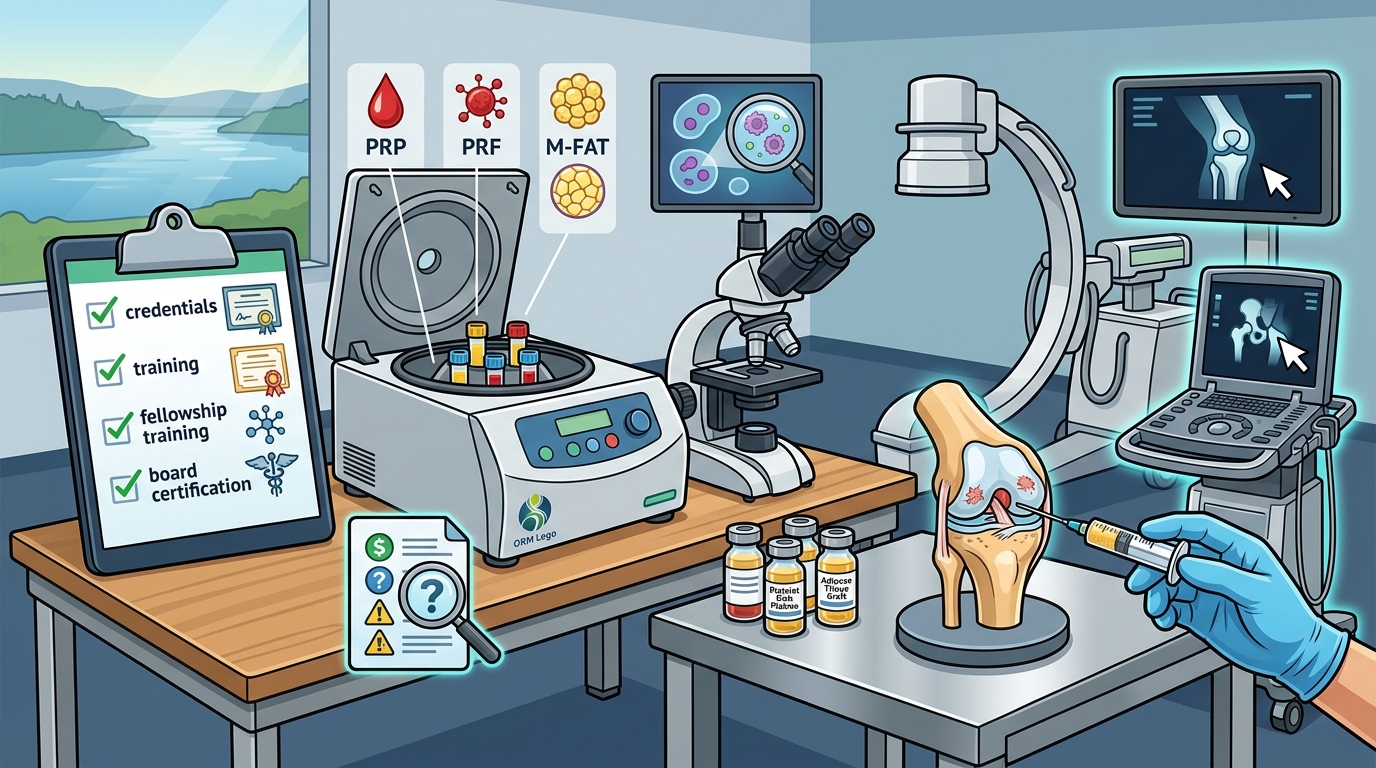
Oregon Regenerative Medicine, for instance, uses four Sonosite ultrasound systems alongside a GE OEC One Flat Panel C-Arm fluoroscopy unit for comprehensive guided regenerative procedures. This level of imaging allows real-time visualization of needle placement in joints, tendons, and spinal structures.
If a clinic cannot tell you specifically what imaging equipment they use, or if they perform injections without any guidance at all, consider it a disqualifying factor.
Step 3: Ask About In-House Laboratory Protocols
The quality of your PRP concentrate and adipose tissue graft depends on how they are prepared. A qualified provider processes biologics on-site using validated laboratory equipment rather than outsourcing preparation or using pre-packaged kits with unverified cell counts.
What to Ask
Request specifics about the clinic's preparation capabilities. Leading practices prepare PRP, PRF (platelet-rich fibrin), M-FAT (micro-fragmented adipose tissue), A2M (alpha-2-macroglobulin), and platelet lysates in their own laboratory. Oregon Regenerative Medicine prepares all of these biologics in-house, customizing platelet concentrations to match each patient's condition.
Autologous processing means the tissue comes from your own body and is prepared and re-injected the same day. This same-day protocol reduces contamination risk and keeps the procedure compliant with FDA guidelines for minimally manipulated autologous tissues under 21 CFR Part 1271.
Step 4: Evaluate Clinical Experience and Case Volume
Regenerative medicine is a skill-intensive specialty. Higher procedure volume correlates with better technique and patient outcomes. Ask how many regenerative injections the clinic has performed and how many years they have focused on orthobiologic treatments.
Oregon Regenerative Medicine has performed over 40,000 regenerative injections and has practiced in Lake Oswego, Oregon, since 1978. They have specialized in regenerative orthopedic medicine for over 25 years, encompassing prolotherapy, PRP, and adipose tissue biocellular therapies. That depth of experience provides a clinical dataset few clinics can match.
Also look for patient outcomes documentation. A reputable clinic should be able to share patient reviews and testimonials that describe specific conditions treated and results achieved.
Step 5: Watch for Red Flags
The regenerative medicine field has attracted providers with minimal training making exaggerated claims. Here are warning signs to watch for:
- Guaranteed outcomes: No treatment has 100% success. Any clinic promising guaranteed results is being dishonest.
- No imaging guidance: Blind injections into complex joint structures are substandard care.
- Allogeneic "stem cell" products marketed as live cells: Many products sold as stem cells contain no viable cells. Autologous (your own tissue) procedures are the gold standard.
- No physical exam or diagnostic workup: A thorough provider reviews your history, imaging, and performs diagnostic ultrasound before recommending any treatment.
- Weekend seminar credentials only: Legitimate regenerative training involves cadaveric workshops, written examinations, and supervised clinical hours.
Provider Qualification Checklist at a Glance
| Qualification Criterion | Qualified Provider | Unqualified Provider |
|---|---|---|
| Medical degree (MD, DO, ND) | Yes, with regenerative specialty training | No medical license or unrelated specialty |
| Board certification or IROM-C | Holds recognized regenerative certification | Weekend seminar certificate only |
| Image-guided injections | Ultrasound and/or fluoroscopy for every procedure | Blind landmark-based injections |
| In-house biologic preparation | PRP, PRF, M-FAT processed on-site | Pre-packaged kits or outsourced processing |
| Case volume | Thousands of documented procedures | Fewer than 100 or undisclosed |
| Autologous tissue protocols | Uses your own adipose and blood products | Sells allogeneic products as "stem cells" |
| Comprehensive evaluation | History, imaging review, diagnostic ultrasound | Minimal exam, immediate upsell |
Key Takeaways
- Biocellular joint treatment is a non-surgical procedure using your own adipose tissue and PRP to regenerate damaged cartilage, tendons, and ligaments.
- Always verify that your provider holds recognized regenerative medicine certifications such as IROM-C from the AAOM or diplomate status from the ABRM.
- Image-guided injections using ultrasound or fluoroscopy are essential for accurate biologic delivery and better outcomes.
- In-house laboratory preparation of PRP, M-FAT, and other biologics ensures quality control and same-day autologous processing.
- High procedure volume (thousands of injections) indicates a seasoned practice with refined clinical protocols.
- Avoid clinics that guarantee results, skip diagnostic workups, or sell allogeneic products as live stem cells.
- Oregon Regenerative Medicine in Lake Oswego has performed over 40,000 regenerative injections since 1978, with full imaging guidance and in-house biologic preparation.
Frequently Asked Questions
What is biocellular joint treatment?
Biocellular joint treatment is a regenerative injection therapy that uses adipose-derived mesenchymal stem cells and platelet-rich plasma harvested from your own body to repair damaged cartilage, tendons, ligaments, and joints without surgery. Learn more about adipose biocellular orthopedics.
What credentials should a biocellular treatment provider have?
Look for a licensed physician (MD, DO, or ND) with specialized regenerative medicine certification such as the IROM-C from the AAOM or board certification from the ABRM, plus documented training in ultrasound-guided and fluoroscopy-guided injection techniques.
Why is image guidance important for regenerative injections?
Ultrasound and fluoroscopy allow the physician to visualize the needle in real time, ensuring biologics are delivered precisely to the damaged tissue. Blind injections risk missing the target entirely, reducing effectiveness and potentially causing harm.
What is the difference between autologous and allogeneic stem cell treatments?
Autologous treatments use cells harvested from your own body (typically adipose tissue or blood), while allogeneic treatments use donor-sourced materials. Autologous procedures carry lower risk of immune rejection and are the standard for reputable biocellular joint therapies.
How many procedures should a qualified clinic have performed?
While there is no universal minimum, clinics with thousands of documented regenerative injections demonstrate the procedural volume needed for refined technique. Oregon Regenerative Medicine has performed over 40,000 regenerative injections.
Does insurance cover biocellular joint treatments?
Most biocellular and PRP procedures are not covered by standard health insurance plans because they are considered elective. However, many patients find the cost favorable compared to surgery, extended rehabilitation, and ongoing pain medication expenses.
How do I know if I am a good candidate for biocellular treatment?
Candidates typically include people with osteoarthritis, meniscus tears, rotator cuff injuries, ligament sprains, or degenerative joint conditions who want to avoid or delay surgery. A qualified provider will conduct a thorough evaluation before recommending treatment. See who is a good candidate for regenerative cell therapy.
What questions should I ask during a consultation?
Ask about the provider's specific training in regenerative medicine, the imaging equipment used during injections, how biologics are prepared, how many similar procedures they have performed, and what outcomes past patients have experienced.
Ready to Find the Right Provider? Start Here.
If you are considering biocellular joint treatment in the Portland or Pacific Northwest area, Oregon Regenerative Medicine offers a comprehensive consultation that includes diagnostic ultrasound, imaging review, and a personalized treatment recommendation. With over 40,000 regenerative injections performed since 1978, their team brings unmatched experience to every patient. Contact Oregon Regenerative Medicine to schedule your evaluation today.