Adipose tissue graft therapy is a regenerative injection treatment that uses your own fat-derived cells to repair damaged joints, tendons, and ligaments without major surgery. If you have been told that joint replacement is your only option, this procedure may offer a less invasive path back to pain-free function. At Oregon Regenerative Medicine in Lake Oswego, Oregon, our physicians have performed thousands of biocellular treatments since 1978. This guide walks you through every stage of the procedure so you know exactly what to expect on treatment day and beyond.
What Is Adipose Tissue Graft Therapy?
Adipose tissue graft therapy is a form of regenerative injection therapy that harvests fat tissue rich in mesenchymal stem cells (MSCs) from your own body and reinjects it into damaged joints or soft tissues. Formerly referred to as a type of "stem cell therapy," the modern clinical term is autologous adipose graft therapy. The harvested tissue contains pluripotent cells, a native tissue matrix, and natural bio-scaffolding that work together to repair and regenerate affected tissues.
Why Adipose Tissue?
Adipose tissue is the most abundant source of reparative mesenchymal stem cells in the human body, according to research published in the journal Frontiers in Pharmacology. It is easy to harvest, requires only local anesthesia, and provides high concentrations of cells that exhibit immunomodulatory and pro-regenerative signaling.
Who Is a Candidate?
Ideal candidates include patients with osteoarthritis of the knee, hip, or shoulder, chronic tendon or ligament injuries, and degenerative disc conditions. Oregon Regenerative Medicine provides a thorough history, physical exam, X-ray and MRI review, and diagnostic ultrasound imaging before determining candidacy. Not all treatments are right for every patient, which is why a comprehensive evaluation comes first.
Pre-Procedure Evaluation
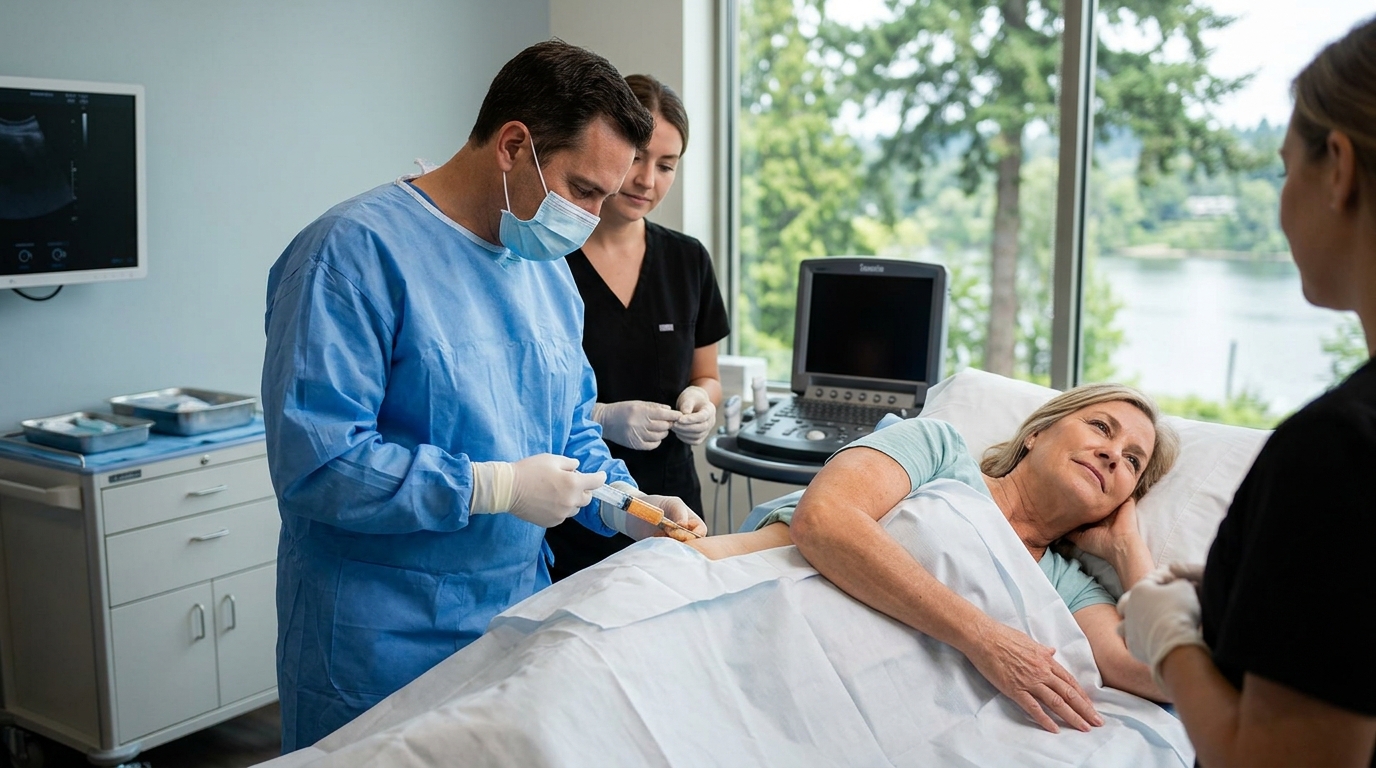
Before your treatment day, your physician will conduct a musculoskeletal ultrasound (MSKUS) exam using one of ORM's four Sonosite ultrasound systems. Unlike a static MRI snapshot, ultrasound allows a functional evaluation of the joint during movement and enables exact needle placement during the actual procedure. Your imaging, lab results, and medical history are reviewed together to build a personalized treatment plan.
Medications to Avoid
Patients are typically asked to discontinue anti-inflammatory medications (NSAIDs) for one to two weeks before the procedure, as these drugs can interfere with the body's natural healing response. Your physician will provide a complete list during your consultation.
Step-by-Step Procedure on Treatment Day
The entire appointment takes approximately 2.5 hours from start to finish. Here is what happens during each phase.
1. Tissue Harvesting
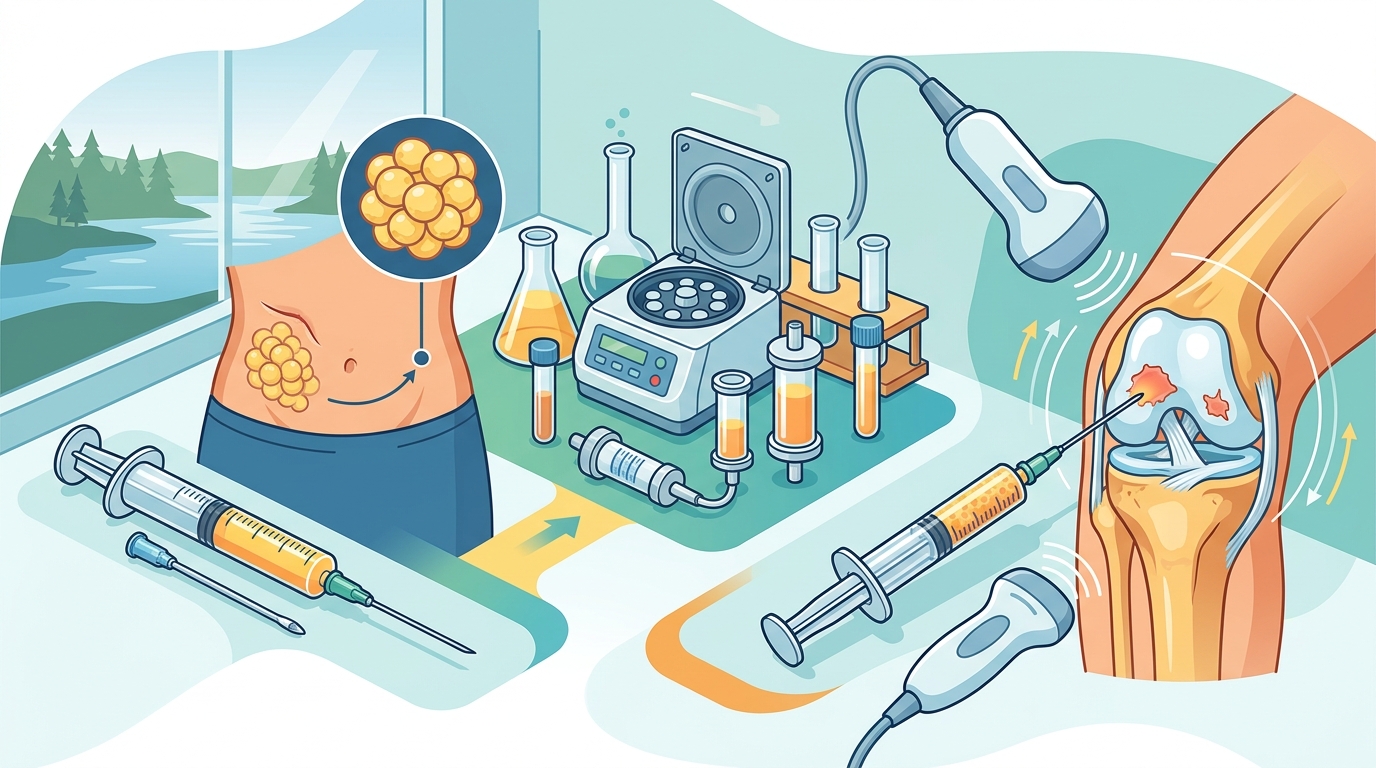
A small quarter-inch incision is made in the skin, typically near the abdomen or flank. A patented tissue harvester is inserted through this incision to extract adipose-derived tissues and cells. The area is numbed with local anesthesia, so most patients experience only mild pressure.
2. Laboratory Processing
The harvested tissue is processed in ORM's in-house laboratory. The cells and tissue matrix are concentrated alongside your platelet-rich plasma (PRP), which is drawn from a simple blood sample. PRP contains hundreds of growth factors that amplify the regenerative effect of the graft. ORM also prepares PRF, M-FAT, A2M, and platelet lysates on-site depending on clinical needs.
3. Guided Injection
The concentrated adipose graft and PRP are injected directly into the affected joint or tissue under real-time ultrasound guidance. For spinal procedures, ORM uses its GE OEC One Flat Panel C-Arm fluoroscopy system for precise delivery into intervertebral discs. This image-guided approach ensures the biocellular material reaches the exact target structure.
Recovery and Follow-Up
Some post-treatment discomfort is normal and typically resolves within several days. Most patients can return to light daily activities within 48 to 72 hours. Strenuous exercise is generally restricted for two to four weeks to allow the graft to integrate.
If additional treatments are needed, adipose graft sessions are spaced approximately one year apart. This contrasts with PRP therapy, which typically requires three to five sessions spaced two to six weeks apart. Your physician will outline realistic expectations at your first evaluation.
Adipose Graft vs. PRP: Quick Comparison
| Factor | Adipose Tissue Graft | PRP Therapy |
|---|---|---|
| Cell Source | Fat tissue (MSCs, scaffolding) | Blood platelets (growth factors) |
| Harvest Method | Small incision with tissue harvester | Standard blood draw |
| Procedure Duration | ~2.5 hours | ~45-60 minutes |
| Typical Sessions | 1-2, spaced ~1 year apart | 3-5, spaced 2-6 weeks apart |
| Image Guidance | Ultrasound or fluoroscopy | Ultrasound |
| Best For | Moderate-to-severe OA, complex joints | Mild-to-moderate tendon/ligament injuries |
| FDA Status | FDA-compliant (autologous, minimally manipulated) | FDA-compliant |
Key Takeaways
- Adipose tissue graft therapy harvests your own fat-derived stem cells to regenerate damaged joints and soft tissues.
- The procedure takes about 2.5 hours and is performed under local anesthesia in an outpatient setting.
- A quarter-inch incision and patented harvester are used to collect tissue with minimal discomfort.
- PRP is concentrated alongside the adipose graft in ORM's in-house lab for maximum regenerative potency.
- Ultrasound and fluoroscopy guidance ensure precise delivery of the biocellular material.
- Recovery typically spans a few days, with follow-up treatments spaced about one year apart if necessary.
- Oregon Regenerative Medicine's treatments are FDA-compliant and use only autologous (your own) tissues.
Frequently Asked Questions
Is adipose tissue graft therapy the same as stem cell therapy?
Autologous adipose graft therapy was formerly known as a type of stem cell therapy. It uses your own fat cells and tissue to alleviate pain and restore joint function, but the term "adipose tissue graft" more accurately describes the procedure.
How long does the procedure take?
From start to finish, the procedure takes approximately 2.5 hours at Oregon Regenerative Medicine's Lake Oswego clinic.
Is the treatment FDA-approved?
Oregon Regenerative Medicine's adipose tissue stem cell grafts and micro-fragmented treatments are in FDA compliance. Because the tissue is autologous and minimally manipulated, it meets current regulatory guidelines.
How many treatments will I need?
Most patients require one or two adipose graft treatments. If additional sessions are needed, they are spaced about one year apart. The number depends on injury severity, joint condition, and individual healing response.
What joints can be treated?
ORM has successfully treated osteoarthritic hips, knees, rotator cuffs, shoulders, elbows, wrists, hands, feet, ankles, TMJs, and spinal conditions using regenerative injection therapies.
Does the procedure hurt?
Local anesthesia is used for both the harvest site and the injection site. Some post-treatment discomfort is normal and generally resolves within several days.
How is this different from PRP?
PRP is derived from your blood and delivers concentrated growth factors. Adipose tissue graft therapy delivers living cells, tissue matrix, and bio-scaffolding in addition to PRP. The two are often used together for a synergistic effect.
Who performs the procedure at ORM?
Dr. Noel Peterson, an international lecturer on prolotherapy and regenerative injection therapy, and Dr. Kristian Flores, who has performed thousands of guided injections, lead the clinical team.
Schedule Your Evaluation
If chronic joint pain is limiting your life and you want to explore a non-surgical alternative, the first step is a comprehensive evaluation. Contact Oregon Regenerative Medicine in Lake Oswego to schedule your consultation and find out whether adipose tissue graft therapy is right for you.